

How to Prepare for NLSAT in 30 Days: A Simple and Practical Plan
Preparing for the National Law School Admission Test (NLSAT) in just 30 days can feel like a big challenge. With a clear plan, though, you can do well. This month, keep these goals in mind:
- Focus on important, high-scoring areas
- Improve how you attempt questions
- Practise in exam-like conditions
Here is a simple, week-by-week strategy you can actually follow.
Understanding the NLSAT Pattern (Quick Overview)
Before you start, make sure you understand the exam format.
Part A – Objective (MCQs)
- Marks: 75
- 75 multiple-choice questions from:
- Reading Comprehension
- Critical & Logical Reasoning
- Current Affairs & General Knowledge
- There is negative marking: you lose 0.25 marks for every wrong or unattempted question.
Part B – Subjective (Written answers)
- Marks: 75
- Two main parts:
- Legal Aptitude / Reasoning: These are short, problem-based questions that check your logic and thinking skills. You don’t need to know any law in advance.
- Analytical Essay: You’ll write an essay on a given topic to show how clearly and logically you can share your ideas.
Exam Duration
- Total time: 150 minutes (2.5 hours) for both parts together
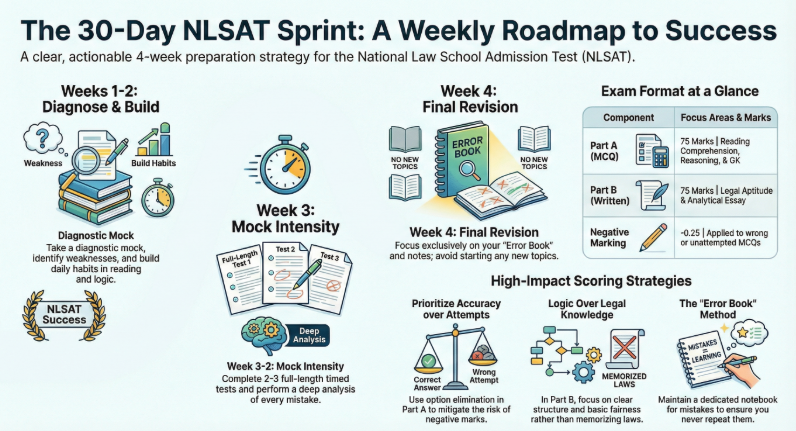
NLSAT 30-Day Preparation Strategy (Week-by-Week)
Week 1 – Find Your Level & Learn the Basics
Goal: Find out your strengths, weaknesses, and what the exam expects. Take a full-length mock test all at once, without taking any breaks.

- Check your performance in detail:
- Which types of MCQs are you getting wrong again and again?
- Are you slow in reading or in reasoning?
- What are the weak points in your Part B (written) answers?
- Write short notes for each topic so you can review them quickly later.
Focus on:
- Reading comprehension techniques (how to read faster and understand better)
- Basic logical reasoning (arguments, inferences, assumptions, conclusions)
- Current affairs and GK from the last 6–12 months
Also:
- Keep a separate notebook for your mistakes and difficult questions. This will be your error book.
Week 2 – Build Skills & Practise Daily
Goal: Strengthen your main skills and reduce repeated mistakes.
Daily practice:
- 3–4 Reading Comprehension passages every day
- Critical reasoning questions (assumptions, strengthen/weaken, conclusions, etc.)
- Small sets of MCQs daily to stay in touch with all areas
Part B Writing Practice:
- Practice writing short, well-organized answers for legal reasoning questions.
- Start writing essays. Focus on:
- Clear thinking before you start writing
- One main idea per paragraph
- Smooth, logical flow from start to end
- A clear conclusion
Remember, your logic matters more than memorizing facts. You don’t need detailed legal knowledge. The exam tests how you think.
Week 3 – Mock Tests & Detailed Review
Goal: Get used to the exam format and learn from your mistakes.
- Aim to take 2 or 3 full mock tests this week, following the time limits.
- After each mock test:
- Go through every question you missed. Ask yourself:
- Did I not understand the concept?
- Did I make a wrong assumption?
- Was it just a careless mistake?
Next, review your Part B answers:
- Is the structure clear?
- Are your arguments logical and easy to follow?
- Is your language simple and correct?
Keep adding to your error book and review those topics often.

Treat every mock test like the real exam. This will help you build stamina, confidence, and manage your time better.
.
Week 4 – Final Revision & Exam Readiness
Goal: Focus on what you already know and avoid confusing yourself by starting new topics.
- Only review your notes and error book now. Don’t start any new topics at this point.
- Take a final set of mocks under timed conditions.
- Revise summaries of current affairs and important GK topics.
- Do some light writing practice. Focus on writing a few good answers or essays instead of many rushed ones.
In your final week, don’t overload yourself. Try a mix of:
- Revision
- Mock analysis
- Proper rest
This is better than panicked, non-stop studying.
Part A – Smart Strategy for MCQs
- Focus on accuracy instead of just the number of attempts, since there is negative marking (minus 0.25 for wrong or unattempted answers).
- For reading and reasoning questions, start by eliminating options that are clearly wrong. This makes it easier to pick the right answer.
- Manage your time. Aim for about 2 minutes per question on average, but don’t rush and make careless mistakes.
Part B – How to Score Well
Part B is mainly about how you think and how clearly you can explain your ideas.
For legal aptitude questions:
- Identify the main issue in the question.
- Use simple logic and basic fairness in your answers.
- Write your answers in short, clear paragraphs.
For the essay:
- Follow a simple structure: introduction, body, and conclusion.
- Avoid using complicated words. Clear language is better than using fancy words.
- Support your points with reasons and examples, not just opinions.
NLSAT 30 days preparation strategy Common Mistakes to Avoid
- Starting completely new topics in the last month
- Taking mocks but not analysing them
- Studying without a revision plan
- Using too many books, courses, or sources at once
- Practising questions randomly without seeing what you learned from them
NLAT Mental Readiness
The last 30 days are also about staying calm and steady.
- Sleep at a regular time and get enough rest.
- Take short breaks to avoid burnout.
- Trust your plan and the effort you’re putting in.
Calm and steady preparation works better than last-minute panic.
How to Prepare for NLSAT in 30 Days: Final Thoughts
Thirty days is enough time to prepare if you stay focused and work smart. If you do the following:
- Understand the exam pattern
- Practise reading and reasoning regularly
- Improve your writing skills
- Take mocks and learn from your mistakes
You can really improve your chances of success.
Stay consistent, stay calm, and do your best. Good luck!
Read More: NLAT Syllabus
LSAT Exam Pattern
FAQs: NLSAT 30 days preparation strategy
Can I realistically crack NLSAT with just 30 days of preparation?
Yes. If you already have basic reading and reasoning ability, a focused 30-day NLSAT preparation strategy that prioritizes mocks, revision, and writing practice can significantly improve your score.
What is the best 30-day study plan for NLSAT preparation?
The best NLSAT 30-day study plan follows a week-wise structure: diagnostic testing in Week 1, skill building in Week 2, mock-heavy practice in Week 3, and focused revision in Week 4.
How should I prepare for NLSAT Part A MCQs in the last month?
In the final 30 days, NLSAT Part A preparation should focus on accuracy, option elimination, reading comprehension practice, and avoiding negative marking through smart attempt selection.
How can I improve my NLSAT Part B writing in 30 days?
To improve NLSAT Part B in one month, practise structured legal reasoning answers and essays regularly, focusing on clarity, logical flow, and simple language rather than legal knowledge.
How many mock tests should I take for NLSAT in the last 30 days?
Ideally, take 1 diagnostic mock in Week 1, 2–3 full mocks in Week 3, and 1–2 final mocks in Week 4, with detailed analysis after every test.
Is legal knowledge required for NLSAT legal aptitude questions?
No. NLSAT legal aptitude questions test logical reasoning and fairness, not prior legal knowledge. Clear thinking and structured answers matter more than legal terms.
What are the most common mistakes in last-month NLSAT preparation?
Common mistakes include starting new topics late, ignoring mock analysis, overloading resources, neglecting writing practice, and studying without a revision plan.
How important is current affairs for NLSAT preparation?
Current affairs and GK from the last 6–12 months are important for NLSAT Part A and should be revised through concise notes rather than extensive reading in the final month.
How should I manage time during the NLSAT exam?
Effective NLSAT time management involves maintaining steady pace in MCQs, avoiding stuck questions, and allocating enough time for clear, structured Part B answers.
Is consistency more important than study hours for NLSAT?
Yes. Consistent daily practice of reading, reasoning, and writing over 30 days is far more effective than long, irregular study sessions.
Tags