
IPMAT Overview: Exam Structure, Eligibility, Syllabus, and Significance


Written by Beena Singh | Reviewed by Jaimin Shah on 15 July, 2026




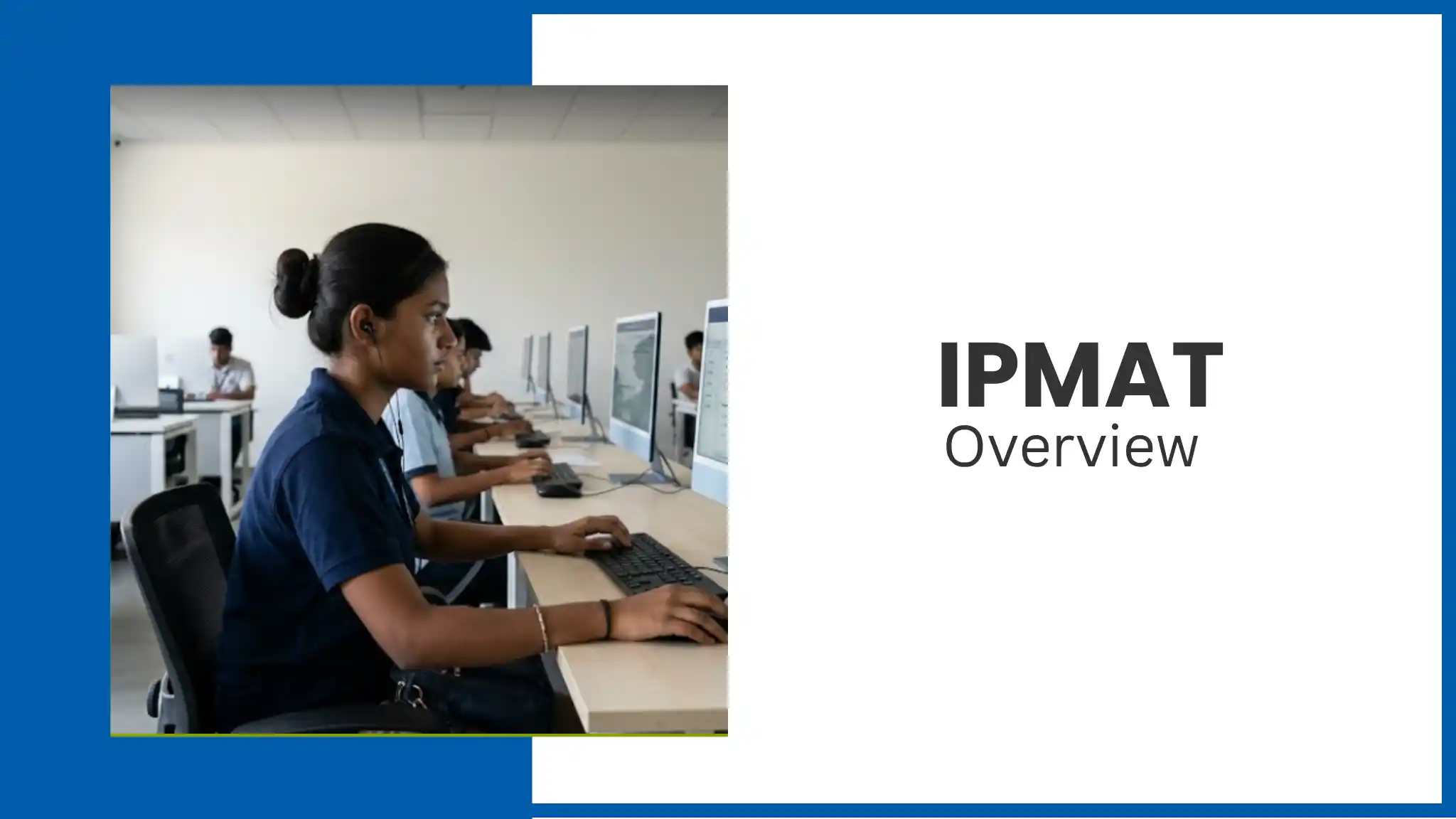

IPMAT stands for the Integrated Program in Management Aptitude Test. This entrance exam is held by IIM Indore for students who want to join its five-year Integrated Program in Management (IPM) right after finishing high school. The program is meant for those wanting to start a management career early. If you want to understand the IPM program, there’s more to know than just what IPMAT stands for. Keep reading to get all the crucial facts about the IPM program and the IPMAT exam.
The IPMAT exam tests your skills in Quantitative Ability (QA), Verbal Ability (VA), and Logical Reasoning (LR). The exam usually has multiple-choice questions and is held online.
With IPMAT, students can join top IIMs right after completing 12th grade and pursue a complete management education alongside their undergraduate studies. This blog will give you all the information you need about the IPMAT exam.
IPMAT Eligibility Criteria
IPMAT Indore Eligibility:
To be eligible, a candidate must fulfill the following criteria:
- The candidate should have been born on or after August 01, 2005. However, candidates from the SC/ST/PwD categories are given a 5-year relaxation, making them eligible if their birth date is on or after August 01, 2000.
- The candidate must have completed Standard XII/HSC or an equivalent examination in 2024 or 2025 or appear for it in 2026.
- IIM Indore does not require a minimum board score, but it’s a good idea to aim for high marks because your board results will play a big role in your overall composite score.
Note:
- Applicants who will complete Standard XII/HSC or an equivalent examination by July 31, 2025, are eligible to apply, as long as they meet the above eligibility criteria. Should they be selected, their admission will be provisional.
- When calculating percentages for Standard X and XII, candidates should include all subjects listed on the mark sheet, irrespective of the Board’s regulations regarding subject count.
IPMAT Rohtak Eligibility:
To be eligible, a candidate must fulfill the subsequent eligibility criteria:

- To be eligible for the General, OBC, and EWS categories, a minimum of 60% in standard X/SSC and standard XII/HSC or equivalent exams is required.
- To qualify for SC, ST, and PWD (DAP) categories, candidates must have a minimum of 55% in standard X/ SSC and standard XII/ HSC or equivalent exams.
- Furthermore, to apply, you must be 20 years of age or younger at the time of application.
Note:
You can apply if you complete Standard XII/ HSC or an equivalent course by June 30, 2026, provided you meet the eligibility criteria. The candidate’s percentage of marks in X and XII standards will be calculated based on the aggregate marks of their best five subjects on the mark sheet/grade sheet, regardless of the Board’s regulations.
IPMAT Exam Pattern
IPMAT Indore:
| Section | No. of questions | Time allotted (mins.) | Total Marks
(+4 for each correct answer.) |
Negative marking
(-1 for incorrect answer.) |
| Quantitative Ability (SA) | 15 | 40 | 60 | No |
| Quantitative Ability (MCQ) | 30 | 40 | 120 | Yes |
| Verbal Ability | 45 | 40 | 180 | Yes |
| Total | 90 | 120 | 360 |
IPMAT Rohtak:
| Section | No. of Questions | Marks | Key Details |
| Quantitative Aptitude | 40 | 160 | Exam Duration: 120 minutes
Marking Scheme: +4 marks for each correct answer; -1 for an incorrect answer No Sectional Timer No Sectional Cutoff. Cutoff at the aggregate level only. Difficulty level: Easy-to-Moderate Calculators not allowed |
| Logical Reasoning & Data Interpretation | 40 | 160 | Same as above |
| Verbal Ability and Reading Comprehension | 40 | 160 | Same as above |
| Total | 120 | 480 | Exam Duration: 120 minutes
Marking Scheme: +4 marks for each correct answer; -1 for each incorrect answer No Sectional Timer  No Sectional Cutoff. Cutoff at the aggregate level only. Difficulty level: Easy-to-Moderate Calculators not allowed |
IPMAT Section-wise syllabus (Indore & Rohtak)
IPMAT Indore Section-Wise Syllabus
| Quantitative Ability | Verbal Ability |
| Number System
Averages and percentages Roots, Indices, and Surds Simple and compound interest Profit & Loss Algebraic Formulae Linear and quadratic equations Ratio and Proportion Partnership Mixtures and Allegations Time, speed, and distance Work-related problems Pipes and Cisterns Geometry: Lines, Angles, and Triangles Polygons, circles, and mensuration Permutations, combinations, probability, Determinants Vectors Integration and Differentiation |
Etymology and Roots
Idioms and Phrases Analogies Antonyms-Synonyms Foreign Words Noun and pronoun errors Subject-Verb Agreement Prepositions and conjunctions Tenses, modifiers, and parallelism Reading Comprehension Inference-based passages Syllogisms Logical Consistency |
IPMAT Rohtak Section-Wise Syllabus
| Quantitative Ability | Logical Reasoning | Verbal Ability |
| Number System
Averages and percentages Roots, Indices, and Surds Simple and compound interest Profit & Loss Algebraic Formulae Linear and quadratic equations Ratio and Proportion Partnership Mixtures and allegations Time, speed, and distance Work-related problems Pipes and Cisterns Geometry: Lines, Angles, and Triangles Polygons, circles, and mensuration Permutations, combinations, probability, Determinants Vectors Integration and Differentiation |
Inferences and judgments
Logical Sequence Series Coding Arrangements Cubes and dimes Blood Relations Input & Output Venn Diagrams Binary Logic Syllogism Statements and Conclusions Statements and Assumptions Probably true or false Strong and weak arguments Course of Action Assertions and Reasons Critical Reasoning |
Reading Comprehension: Question types broadly involve Specific details, Main idea, Tone, Title, Inference and Contextual vocabulary.
Vocabulary: This includes questions on Synonyms, Antonyms, Confusing words, Contextual vocabulary-based fill-in-the-blanks, Idioms/Phrases, Etymology and Roots, foreign words, Sentence Completion, etc. Grammar: This includes Parts of speech, Connectors, Direct and Indirect speech, Voice, Subject-verb agreement, Parallelism, and Modifiers. Question formats may include error spotting, error correction, fill-in-the-blanks, etc. Verbal Reasoning: This includes Analogies, Paragraph completion, Para jumbles, and Logical consistency. |
Top Colleges Accepting IPMAT Scores
There is a lot more to learn about this exam than just the IPMAT full form. After all, which colleges accept IPMAT scores is also critical information. Here, we’ve compiled an exhaustive list of colleges accepting IPMAT Indore and IPMAT Rohtak scores.
| College Name | Seat Intake |
| IIM Indore | 150 |
| IIM Ranchi | 120 |
| IIM Amritsar | 60 |
| IIM Sirmaur | 120 |
| IIM Rohtak (Accepts IPMAT Rohtak Scores) | 198 |
| IIM Bodhgaya (Accepts JIPMAT Scores) | 120 |
| IIM Jammu (Accepts JIPMAT Scores) | 140 |
| IIM Shillong | 45 |
| IIM Sambalpur | 90 |
| IIFT Kakinada | 60 |
| NIRMA University | 240 |
| NALSAR, Hyderabad | 66 |
| TAPMI, Manipal | 60 |
In conclusion, IPMAT is more than an entrance exam; it is also an entry point to a valuable educational opportunity at one of India’s top management institutes. It checks if students are ready for a challenging academic and vocational journey. By preparing carefully and comprehending the exam, you can improve your chances of admission and build a firm foundation for a successful management career.

IPMAT Frequently Asked Questions
IPMAT is an entrance test for getting into the 5-year Integrated Programme in Management (IPM) courses. If you have finished or are currently in Class 12, you can apply, as long as you meet the specific eligibility rules of each institute.
IPMAT Indore and IPMAT Rohtak are different entrance exams. IPMAT Indore checks Quantitative Ability and Verbal Ability. IPMAT Rohtak covers Quantitative Aptitude, Logical Reasoning, Data Interpretation, and Verbal Ability with Reading Comprehension. Also, the difficulty of IPMAT Indore is much higher than that of IPMAT Rohtak.
The exam pattern differs between IPMAT Indore and IPMAT Rohtak. IPMAT Indore has 90 questions worth 360 marks. IPMAT Rohtak has 120 questions for 480 marks. Both exams last 120 minutes. IPMAT Indore has sectional timing, whereas IPMAT Rohtak doesn’t.
The IPMAT syllabus includes Quantitative Ability and Verbal Ability. Some exams also have Logical Reasoning and Data Interpretation. Topics can include arithmetic, algebra, grammar, vocabulary, and reading comprehension.
Colleges that accept IPMAT scores include IIM Indore, IIM Rohtak, IIM Ranchi, IIM Amritsar, IIM Sirmaur, IIFT Kakinada, NIRMA University, NALSAR Hyderabad, TAPMI Manipal, NICMAR Pune, and others.
IPMAT is competitive because it checks your understanding, speed, accuracy, and time management. Practising regularly and knowing the exam pattern, your strengths, and weaknesses can help you do better.
Start by learning the syllabus and exam pattern. Work on your basics, solve past years’ questions and mock tests, and check your progress often to improve speed and accuracy.