

How Specialized M.Tech Programs Prepare Graduates for Today’s Industry Demands?
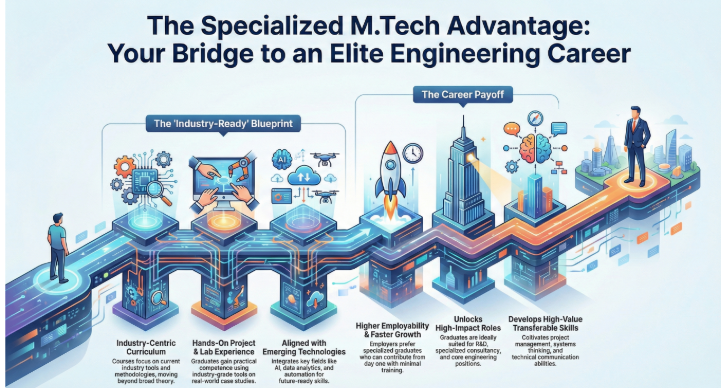
Specialized M.Tech programs are strategic career investments designed to bridge the persistent gap between broad engineering theory and modern industry demands for graduates with deep domain expertise and practical, industry-ready skills. These programs achieve this by offering an Industry-Centric Curriculum Design focused on current tools and methodologies, building a Strong Foundation in Applied Research and Innovation through problem-driven dissertations, and ensuring Hands-On Exposure via advanced labs and real-world projects. Furthermore, they maintain Alignment with Emerging Technologies like AI and data analytics and foster Industry Interaction and Networking Opportunities, resulting in graduates who possess high-value, Transferable Skills and enjoy Higher Employability and Career Growth in specialized consultancy, R&D, and core engineering roles. Now, let us learn in detail about each benefit.
Industry-Centric Curriculum Design
One of the strongest advantages of specialized M.Tech programs is their focused and industry-aligned curriculum design.
- Courses are aligned with current industry tools, technologies, and methodologies.
- Syllabi are periodically revised based on industry feedback, innovation trends, and applied research.
- Emphasis is placed on depth rather than breadth, enabling mastery in a specific engineering domain.
For example, instead of revisiting general civil engineering concepts, an M.Tech specialization for industry, such as Water Resources, Structural Engineering, or Transportation Engineering, allows students to gain advanced exposure to modeling, design standards, and real-world engineering applications.
Outcome: Graduates become immediately valuable to employers, reinforcing the value of industry-focused M.Tech courses with minimal training time.
Strong Foundation in Applied Research and Innovation
Modern industries increasingly rely on research-driven engineering solutions. Specialized postgraduate engineering programs are inherently designed to develop this research mindset.
- Students work on problem-driven dissertations and applied research projects
- Exposure to simulation, modeling, optimization, and data analysis
- Training in reading, interpreting, and applying technical and industrial literature
This foundation prepares graduates for:

- R&D and innovation teams
- Technology-driven startups
- High-impact industrial problem-solving roles
Outcome: Graduates of specialized M.Tech programs can analyze complex systems and propose scalable, data-backed solutions aligned with industry needs.
Hands-On Exposure Through Projects and Labs
Today’s employers value practical competence as much as academic credentials. M.Tech programs aligned with industry demands integrate theory with hands-on learning.
- Advanced laboratories using industry-grade tools and software
- Mini-projects and capstone projects based on real-world case studies
- Collaborative projects involving industry-academia partnerships
This approach ensures students are not just familiar with concepts but can also apply, test, and validate engineering solutions.
Outcome: Graduates gain confidence and professional readiness through hands-on learning in M.Tech programs.
Alignment with Emerging Technologies and Trends
Industries evolve faster than traditional degree structures. Specialized M.Tech programs are better positioned to adapt to emerging trends.
- Integration of AI, machine learning, automation, data analytics, and sustainability
- Exposure to interdisciplinary engineering approaches
- Focus on future-ready skills rather than outdated practices
This adaptability enables graduates to remain relevant in fast-changing technical sectors.
Outcome: Graduates of industry-oriented M.Tech programs are prepared not only for current roles but also for future industry demands.
Read More: Study Abroad Using GATE Score
Industry Interaction and Networking Opportunities
A key advantage of M.Tech specialization for the industry is strong industry interaction.

- Guest lectures by industry professionals
- Industry-sponsored research and consultancy projects
- Internships and collaborative research opportunities
- Participation in technical conferences, workshops, and symposiums
These interactions provide insights into:
- Industry expectations
- Professional engineering culture
- Emerging career pathways
Outcome: Graduates build strong professional networks through industry-academia collaboration even before entering the workforce.
Development of High-Value, Transferable Skills
Beyond technical expertise, specialized M.Tech programs focus on holistic skill development.
- Analytical and systems thinking
- Technical communication and documentation
- Project management and teamwork
- Ethical and sustainable engineering practices
These transferable skills enhance long-term employability across industries.
Outcome: Graduates emerge as well-rounded, industry-ready professionals, not just technical specialists.
Higher Employability and Career Growth
Employers increasingly prefer candidates who can contribute from day one. Graduates from industry-focused M.Tech programs stand out due to:
- Domain-specific expertise
- Research and project experience
- Familiarity with industry-standard tools
- Ability to solve complex, niche engineering problems
Such graduates are well-suited for:
- Core engineering roles
- Specialized consultancy positions
- R&D and innovation teams
- Long-term leadership roles
Outcome: Faster career progression and strong alignment with high-impact engineering roles.
Conclusion
Specialized M.Tech programs are no longer just academic credentials; they are strategic career investments. By combining focused technical knowledge, applied research, hands-on exposure, and industry interaction, these programs prepare graduates to meet modern industry demands effectively.
In a world where engineering specialization drives innovation and competitiveness, choosing the right M.Tech specialization for industry can be the key to building a relevant, resilient, and rewarding engineering career.
FAQs: Specialized M.Tech Programs
How do specialized M.Tech programs prepare graduates for industry demands?
Specialized M.Tech programs prepare graduates for industry demands by offering domain-focused curricula, hands-on project exposure, and applied research opportunities. These programs emphasize real-world problem-solving, making graduates industry-ready from day one.
What is the difference between specialized M.Tech programs and general M.Tech programs?
The key difference is depth versus breadth. Specialized M.Tech programs focus deeply on a specific domain aligned with industry requirements, while general M.Tech programs cover broader engineering concepts with limited industry alignment.
Are specialized M.Tech programs better for industry-oriented careers?
Yes, industry-oriented M.Tech programs are designed to match current industry tools, technologies, and workflows. Graduates often require less training and can contribute faster in core engineering and applied roles.
How do M.Tech specializations improve employability in engineering jobs?
M.Tech specialization improves employability by developing domain expertise, applied research skills, and familiarity with industry-standard tools. Employers prefer specialized postgraduate engineering graduates for niche and high-impact roles.
Do specialized M.Tech programs include hands-on learning and real-world projects?
Most specialized M.Tech programs integrate advanced labs, mini-projects, and capstone projects based on real industry problems. This hands-on learning helps bridge the gap between academic theory and industrial application.
How important is applied research in specialized M.Tech programs?
Applied research is a core component of specialized M.Tech programs. Students work on problem-driven dissertations, simulations, and optimization studies that align closely with industry and R&D requirements.
Are specialized M.Tech programs aligned with emerging technologies?
Yes, many industry-focused M.Tech programs integrate emerging technologies such as artificial intelligence, data analytics, automation, sustainability, and interdisciplinary engineering approaches.
What industries prefer graduates from specialized M.Tech programs?
Industries such as manufacturing, infrastructure, energy, IT, analytics, automotive, and research-driven sectors actively prefer graduates from specialized M.Tech programs due to their domain-specific expertise.
Can specialized M.Tech programs help in long-term career growth?
Specialized M.Tech programs support long-term career growth by building strong technical foundations, research capability, and transferable skills such as systems thinking and project management, which are essential for leadership roles.
Is a specialized M.Tech program suitable for students aiming for R&D or innovation roles?
Yes, specialized postgraduate engineering programs are particularly suitable for R&D, innovation teams, and technology-driven startups due to their strong emphasis on applied research and problem-solving.