

Urbanization, Livability, & Smart Cities in India: Is India Future-Ready? GD Discussion
India is urbanizing at a speed the world has rarely seen. Nearly, every Indian is moving to a city in search of jobs, education, healthcare, and better lives. By 2030, more than 600 million Indians are expected to live in urban areas. This rapid shift raises a critical question: Is India truly future-ready when it comes to urbanization, smart cities, and livability? Are smart cities in India future-ready? The answer is complex and contested.
On paper, India has ambitious plans, smart cities mission in India, metro expansions, digital governance, and green energy transitions. On the ground, however, cities struggle with traffic congestion, water shortages, air pollution, housing crises, and unequal access to basic services. India’s rapid urbanization is creating a paradox where cities are becoming simultaneously more developed and more dysfunctional.
So, is India building cities of the future, or are we merely adding technology to broken systems?
Understanding the Core Concepts: Urbanization, Livability, and Smart Cities in India
It’s important to understand what these terms actually mean.
Urbanization in India
Urbanization refers to the migration of people from rural to urban areas and the expansion of cities. In India, this process is unplanned and uneven, driven largely by economic necessity rather than strategic urban planning.
Smart Cities
Smart cities are not just about Wi-Fi, sensors, or apps. A truly smart city integrates technology, governance, sustainability, and citizen participation to improve quality of life. The use of digital tools such as IoT (Internet of Things), AI, and data analytics focus on enhancing the public services like waste management, water supply, traffic systems, and energy efficiency.
Livability
Livability focuses on how comfortable, healthy, safe, and inclusive a city is. It includes:
- Affordable housing
- Clean air and water
- Reliable public transport
- Green spaces
- Healthcare and education access
- Social equity
A city can be technologically advanced yet deeply unlivable.
The Case Against: Smart Cities in India – Is India Future-Ready?
1. Smart Cities Without Smart Planning
One of the biggest criticisms is that India’s smart city development often focuses on small pockets rather than the entire city. While a central business district may have smart traffic lights and clean footpaths, surrounding areas still face:
- Poor sanitation
- Inadequate housing
- Traffic chaos
- Flooding during monsoons
This creates islands of efficiency in oceans of dysfunction.
2. Livability Crisis in Indian Cities
Despite technological upgrades, Indian cities consistently rank low on global livability indices. Major challenges include:
- Severe air pollution
- Water scarcity (Bengaluru, Chennai)
- Long hours of traffic jams and commuting hours
- Rising cost of housing
A city cannot be called future-ready if its residents are physically and mentally exhausted just surviving daily life.
3. Inequality and Exclusion in Urban Growth
Urbanization in India often benefits the middle and upper classes disproportionately. Migrant workers and informal sector employees live in slums and unauthorized settlements, largely excluded from smart city benefits. If smart cities deepen inequality instead of reducing it, the model itself becomes unsustainable.
Urbanization & Smart Cities in India: Will India Be Future-Ready and Livable for its Citizens?
Lets’ check whether urbanization with smart cities in India will be equitable, sustainable, and conducive to dignified living for all citizens. What are the challenges to the urbanization in India?
1. The Urbanization Scale and Scope
India’s urbanization trajectory is staggering in scope. The nation is projected to add approximately 600 million urban residents by 2050. This isn’t merely a statistical shift; it represents one of the largest human migrations in history, concentrated within a single nation’s borders.
This demographic shift has profound implications. According to UN projections, by 2050, urban areas will house 951 million Indians, representing the largest urbanization wave in human history. Concurrently, urban areas already contribute 63% to India’s GDP, a figure projected to reach 75% by 2030.
The scale creates complexity. Managing the infrastructure needs of 600 million additional urban residents means 144 million new homes, thousands of kilometers of roads, water systems for expanded populations, and disposal infrastructure for waste. India’s current infrastructure investment averages only half of the required. This funding gap is the first critical failure point in India’s urban future readiness.
2. The Small City Phenomenon
The real story of Indian urbanization unfolds in smaller cities. More than 70% of India’s urban population lives in settlements with fewer than 1 million inhabitants. This distribution fundamentally changes how we must think about urban development. Small and medium-sized cities (populations between 100,000 and 500,000) are experiencing explosive growth but lack:
- Adequate urban planning frameworks
- Fiscal resources for infrastructure development
- Technical expertise in municipal administration
The rapid growth of smaller cities creates a cascading effect. Infrastructure pressure spreads across a wider geographic area, making centralized solutions ineffective. Cities like Lucknow, Bhopal, Chandigarh, and Nagpur face acute challenges in accommodating growth while maintaining basic service delivery of education, healthcare, and job market. Unlike megacities, which attract investment and policy attention, smaller cities often languish in the planning gaps.
3. The Smart Cities Mission – Progress and Shortcomings
On paper, India’s Smart Cities Mission (launched in 2015) appears successful. By July 2025, 7,636 projects have been completed and ₹1.53 lakh crores have been invested. 18 cities have fully implemented all their smart city projects and 100 cities are part of the scheme across India.
These metrics suggest an ambitious and partially successful initiative. Cities like Pune, Surat, Vadodara, Coimbatore, and Udaipur have completed their smart city projects, implementing innovations in:
- Smart traffic management systems
- IoT-enabled waste management
- Integrated Command and Control Centers (ICCCs)
- Smart mobility solutions (e-buses, metro integrations)
- Digital governance platforms
- Smart water management (SCADA systems)
The Smart Cities Mission represents a significant ideological shift from reactive urban management to proactive smart planning. In this sense, India has demonstrated the will and administrative capacity to execute complex, multi-stakeholder projects across 100 cities simultaneously.
4. Qualitative Limitations: Where the Mission Falls Short
However, beneath these impressive numbers lies a more troubling reality. The Smart Cities Mission, despite its scale, addresses only a fraction of India’s urbanization challenges:
Geographic Limitation:
Only 100 cities are covered under the Smart Cities Mission, representing approximately 30% of India’s urban population. The remaining 70% of urban residents live in cities and towns not included in the scheme. This exclusion is particularly damaging for the 70% of urbanites living in smaller cities, most of which fall outside the mission’s purview. The mission thus leaves the most rapidly growing segment of urban India largely unsupported.
Implementation Delays:
Despite the 93% completion rate cited in official statistics, significant delays persist. Land acquisition and clearances account for approximately 10% of project delays. Beyond headline numbers, many completed projects have not achieved their intended functionality, and infrastructure has been built without corresponding capacity to manage it effectively.
Financing Constraints:
The Smart Cities Mission, despite receiving ₹1.50 lakh crore in investment, faces persistent financing challenges. The scheme relies on a mixed financing model:
- Central government contribution: Limited allocation
- State/municipal contributions: Often inadequate due to limited tax bases
- Public-Private Partnerships (PPPs): Complex, time-consuming, and often unsuccessful
- Commercial loans: Creating debt burdens for financially weak municipalities
This fragmented financing structure has created delays and incomplete projects. Additionally, maintenance of completed projects remains underfunded. Smart systems require continuous investment in upgrades, staff training, and operational costs.
Governance and Institutional Challenges:
The Smart Cities Mission operates within India’s complex urban governance structure, where authority is distributed across multiple tiers—national, state, and municipal. Coordination between these entities remains weak. State governments often prioritize different objectives than the Smart Cities scheme, leading to misaligned efforts. Municipal corporations, already under-resourced, lack the institutional capacity to implement sophisticated smart technologies effectively.
The Inclusion Problem
Perhaps most critically, the Smart Cities Mission has failed to address the fundamental livability question for India’s poorest urban residents. Approximately 25% of urban dwellers live below the poverty line, and 17% of urban households reside in slums (Census 2011). The Smart Cities Mission has been criticized for gentrifying urban spaces, driving property values upward, and inadvertently displacing low-income communities.
Smart city projects often focus on:
- High-tech surveillance systems
- Premium public spaces designed for middle-class use
- Commercial districts and business hubs
- Technology parks and knowledge centers
Meanwhile, the immediate needs of slum dwellers, such as adequate sanitation, drinking water, basic healthcare, affordable housing remain unaddressed. The result is smart cities are built for the digital elite, while the urban poor remain trapped in conditions of severe deprivation. This represents not merely an infrastructure failure but an ethical failure in urban development philosophy.
Given historical patterns, India is likely sliding into this dual-city model in many metropolitan areas. The poor are being pushed to city peripheries, living in conditions of severe deprivation.
5. The Livability Crisis – What The Data Reveals
Housing: The Acute Shortage
India faces one of the world’s most severe housing crises. This isn’t merely a statistical problem; it represents the lived reality of urban homelessness and overcrowding. The crisis is particularly acute for low-income groups as 70% of housing shortage affects families earning less than ₹5 lakhs annually.
Slums across Indian cities house approximately 120 million people in conditions of severe overcrowding. Average slum density reaches 40+ persons per thousand square meters—compared to standard recommendations of 8-10. Many slum dwellers lack tenure security, living on land they don’t own and lacking basic legal protection.
The government has launched programs like Pradhan Mantri Awas Yojana to address housing shortage, but implementation has been slow and inadequate.
Transportation: Congestion and Inequality
Indian cities are gripped by a transportation crisis that simultaneously reflects underinvestment in public systems and overreliance on private vehicles. Traffic congestion costs India ₹22 billion annually in lost productivity. Cities lose 4-8% of productivity annually to transportation inefficiency.
Average commute times in Indian metropolitan areas exceed 90 minutes daily in many areas. Public transportation systems remain inadequate relative to demand. The Smart Cities Mission has attempted to address this through smart mobility solutions—metro integration, e-bus systems, traffic optimization. But these solutions remain piecemeal and inadequately funded.
Water and Sanitation: Invisible Crises
Urban India faces persistent water and sanitation challenges despite urbanization. Approximately 50% of urban India lacks reliable 24-hour water supply. Groundwater depletion is severe in many metropolitan areas. Water quality remains poor, with microbial contamination common in piped water. Seasonal water shortages affect even major cities like Bangalore, Delhi, and Chennai.
The paradox: as cities urbanize, water infrastructure fails to keep pace. Population growth outstrips system capacity. Aging infrastructure results in 30-50% water loss through leakage in many cities. The poor, lacking piped connections, rely on expensive tanker supplies, often purchasing water at 5-10 times the price of piped supply.
Sanitation Challenges:
While open defecation has declined, urban sanitation remains inadequate. Approximately 40% of urban households lack access to proper sewer connections. Septage (fecal sludge) management is virtually nonexistent in most cities. Untreated sewage contaminates groundwater and surface water.
Sanitation workers face severe occupational hazards with minimal protection or dignity. Smart Cities Mission investments in sanitation have helped, but coverage remains spotty and maintenance inadequate. Slum areas particularly lack proper sanitation infrastructure, creating severe public health risks.
Pollution and Environmental Degradation
Indian cities are among the world’s most polluted. Air quality in Delhi, Mumbai, and other metropolitan areas regularly reaches hazardous levels. Delhi experiences Air Quality Index ratings of 400-500+ during winter months (hazardous). Respiratory diseases are among the leading causes of urban mortality. Water pollution from industrial waste and untreated sewage is endemic. Urban heat island effects have increased city center temperatures by 3-4 degrees above surrounding areas
Rapid urbanization has accelerated environmental degradation through:
- Loss of green spaces (urban forests reduced by 40% in many cities)
- Concrete replacing permeable surfaces (increasing flood vulnerability)
- Unplanned industrial zones adjacent to residential areas
- Absence of waste management systems for the massive quantities of garbage generated
Climate change amplifies these challenges. Urban flooding is increasing in frequency and severity. Heat waves pose direct public health threats, particularly to vulnerable populations.
Quality of Life Indices: India’s Poor Showing
Indian cities consistently rank poorly on global livability indices. Most Indian cities rank below 150 globally (out of ~231 cities). Only Delhi and Mumbai feature in the top 100 most livable cities globally. Many Indian cities score below 50 (on a scale where 100 is excellent). These poor rankings reflect structural livability deficits:
- Poor housing quality and affordability
- Inadequate transportation infrastructure
- Severe pollution and environmental degradation
- Limited healthcare and educational infrastructure
- High crime rates and safety concerns
- Insufficient recreational and cultural facilities
For most ordinary Indians, urbanization has meant material improvement in employment opportunities but deterioration in living conditions—longer commutes, worse air quality, inadequate housing, and social alienation in crowded, unplanned urban spaces.
Prepare for CAT GDPI Topics
Now, that you have crossed the first hurdle of cracking the CAT exam, it’s time to focus on the next stage. It’s about preparing for Group Discussion (GD), Written Ability Test (WAT) & Personal Interview (PI) round from the IIMs and other prestigious B-Schools like XLRI, FMS, MDI, SP Jain, NMIMS and SIBM.
Click to Prepare for GDPI Round
During the GD-WAT-PI selection process, you compete with the best of the best and it is but natural that you would want to be coached by the leading experts in the field of Personality development and GDPI training.
Also read, how to prepare for CAT GDPI topics.
The Structural Barriers to Future Readiness of Indian Smart Cities
Governance: Fragmented Authority and Weak Accountability
Indian urban governance is characterized by fragmented authority that prevents coherent urban development. There is a a multi-tier problem. The urban governance in India involves:
- Central government
- State governments
- Municipal corporations
- Special Purpose Vehicles and boards
This layered structure creates overlaps, gaps, and contradictions. When a city needs to implement an integrated urban development strategy, coordination between these entities is difficult. Projects approved at the state level may conflict with municipal plans. Central government schemes often lack alignment with local priorities.
Weak Local Governance:
Municipalities, the grassroots urban governance entity, are significantly under-resourced. Dependency on central/state government grants creates fiscal vulnerability and limited borrowing capacity prevents municipalities from investing in major infrastructure.
Urban governance is plagued by corruption and bureaucratic inefficiency. Land grabbing affects urban expansion planning. Zoning laws are unenforced, leading to haphazard development. These governance failures create an environment where rapid urbanization generates chaos rather than order.
Financial Constraints: The Persistent Gap
India’s urban infrastructure financing is fundamentally inadequate for the urbanization challenge ahead. Current urban infrastructure is financed through:
- Central government budgets: Limited allocation, with competing priorities
- Municipal taxes: Inadequate collection capacity
- State government support: Inconsistent and insufficient
- PPPs: Complex, slow to implement, often unsuccessful
- Borrowing: Limited because municipal creditworthiness is poor
This financing crisis means that, absent significant policy changes, India will likely face a situation where cities cannot maintain infrastructure adequately. Streets deteriorate. Water systems fail. Waste accumulates. Public transportation becomes dysfunctional.
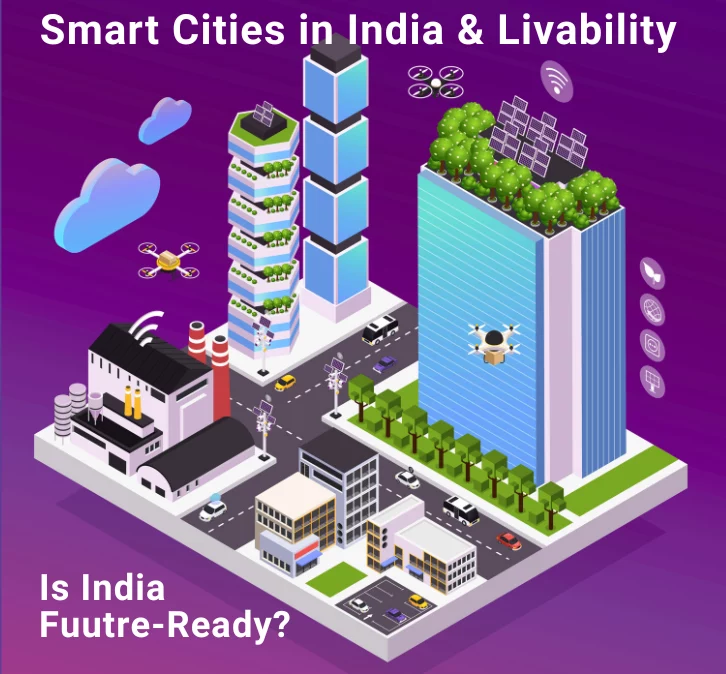
The Caution for Livability: Why Smart Cities in India May Not Be Future-Ready?
Balanced against reasons for optimism are substantial structural challenges suggesting India might not successfully navigate urbanization in smart cities mission in India.
Government Cannot Fund Urbanization Alone
The scale of India’s urbanization challenge exceeds the government’s fiscal capacity. 144 million new homes needed by 2070 and 25 million kilometers of additional infrastructure are required. Environmental remediation needs in existing cities with the maintenance of existing infrastructure.
Central government budgets are finite and other priorities demands attention, such as rural development, education, healthcare, and defense. Even with optimal allocation, government financing cannot meet urbanization’s full requirements. Private sector investment must supplement government spending.
Urbanization Outpacing Infrastructure Development
India’s urbanization is proceeding faster than infrastructure development can match. Population growth rate in urban areas is 2-3% annually, but infrastructure development rate is significantly slower. Each year, the gap between need and provision widens. Resultantly, backlog accumulates which creates compounding pressure.
Conclusion: Is India Future-Ready With Urbanization & Livability?
The honest answer is that India is partially future-ready, but dangerously underprepared in execution. India has vision, scale, and innovation capacity. What it lacks is coordinated urban planning, inclusivity, and long-term thinking. Smart cities without livability will not sustain India’s demographic and economic ambitions. The future of India will be decided not just by how many cities become “smart,” but by how many become livable, equitable, and resilient.
Tags