

Should Elections in India be State-Funded? Can State-Finding Fix Criminalization Of Politics?
According to the Association for Democratic Reforms’ report, in 2024 Lok Sabha elections, 16% candidates out of 1618 candidates, have declared criminal cases. Among them, 10% were facing serious charges like attempted murder. These are not just alleged criminals. They are convicted criminals, people who’ve been to court, faced charges, and somehow still ended up making laws for 1.4 billion people. Can state funding of elections fix this?
Another report by the ADR and the National Election Watch, 36% of the newly elected Rajya Sabha candidates have criminal cases against them. Additionally, 21% of the candidates have assets exceeding Rs 100 crore, indicating substantial wealth in politics.
It’s not just about “bad apples” in Indian politics. It’s a systematic problem rooted in money, the unholy nexus between cash, criminals, and political power that has become the backbone of Indian electoral politics. The question isn’t whether criminalization of politics exists in India. It does. The real question is whether state-funded elections can actually fix it.
What is State Funding of Elections – Can It Fix Criminalization of Politics?
State funding of elections refers to a system where the government directly provides financial resources to political parties and candidates for election campaigns. It reduces their dependence on private donations.
Types of State-Funded Elections in India (Current & Proposed)
1. Direct Funding
- Government directly gives money to political parties or candidates for campaign expenses.
- Rarely implemented due to fears of government misuse.
2. Indirect Funding (Currently Exists)
- Free media access on public broadcasters (national parties get airtime).
- Subsidized campaign materials and venue access.
- Tax exemptions under the Income Tax Act.
- Security and office space for recognized parties
Current Reality: India already has a partial state-funding system and it’s just inadequate and unequally distributed.
How State Funding of Elections Works: The Mechanism
Step 1: Fund Allocation
- Government decides total budget for elections.
- Criteria decision for eligibility (national vs. state parties, independent candidates).
- Formula calculation for distribution, such as equal split, weighted by votes, etc.
Step 2: Implementation
- Money transferred to party accounts or candidate accounts.
- Strict monitoring of expenditure.
- Due diligence with Regular audits and transparency requirements.
Step 3: Compliance
- Political parties cannot accept private donations above a threshold.
- Spending caps enforced on cash.
- If violated the terms or rules, it will result in penalties.
Argument ‘For’ State Funding to Curb Criminalization
State funding of elections would reduce the dominance of money and muscle in politics. It can break the politician-criminal nexus, and allow deserving candidates to compete on equal footing. Let’s understand more benefits of state funding of elections in India:
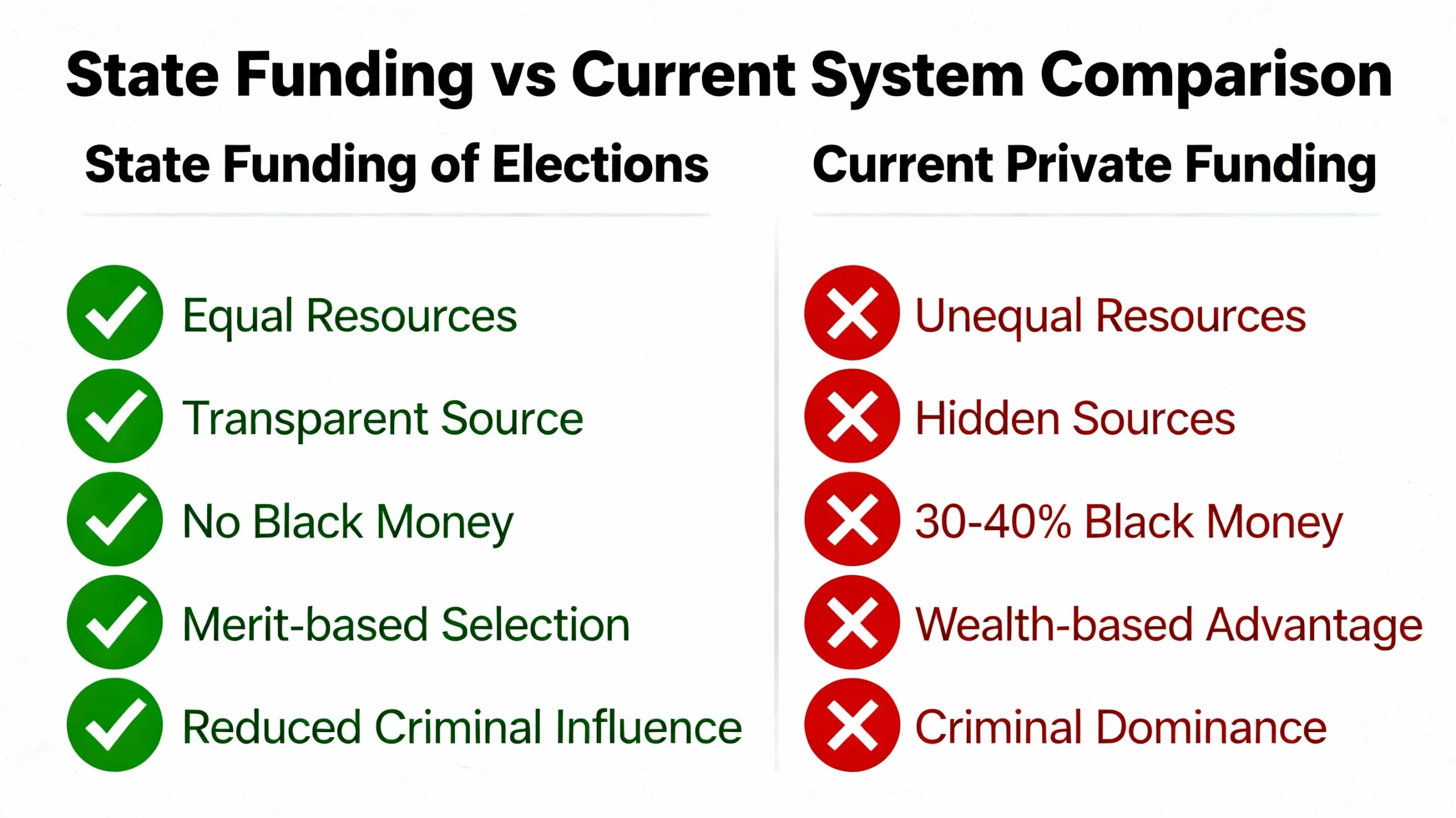
1. Levels the Playing Field
Currently, politics is reserved for the wealthy, those with criminal connections, and those backed by corporate houses.
State funding would democratize the access to elections by:
- Providing equal resources to all candidates.
- Removing wealth as a barrier to entry.
- Allowing merit-based selection by parties.
- It prevents criminal governance and saves taxpayer’s money through reduced corruption, and fewer scams.
2. Reduces Black Money in Elections
Current estimates suggest 30-40% of election funding comes from black money. This black money:
- Comes from criminal enterprises
- Requires quid pro quo arrangements
- Creates obligation between politicians and criminals
State funding cuts source of black money entirely because:
- All funds and donations are legitimate.
- All expenditures are tracked with transparency.
- Criminal sources cannot disguise the origin of funding.
3. Integrity of Candidate Selection
With state funding parties cannot justify choosing criminals based on financial might. They’d be forced to evaluate:
- Actual policy ideas of the candidates.
- Track the records of public service.
- Educational qualifications of the candidates.
- Candidates’ commitment to governance.
It will bring transparency in the electoral process. State funding usually comes with mandatory auditing, expenditure caps, and real-time disclosures. This means cleaner elections and less corruption.
4. Promotes Democracy
State-funded elections help improve the democracy as well as intra party democracy. The dominance of wealthy individuals within political parties reduces and party positions within a political party will be selected on merit, rather than wealth. Additionally, party candidates can have to focus more on important public issues and governance. This leads to more citizen-centric governance.
5. Supported by Multiple Expert Committees
This isn’t fringe thinking. India’s own legal and institutional frameworks have endorsed this, such as Law Commission of India, Administrative Reforms Commission, and Multiple Supreme Court observations.
What India’s Committees Have Recommended for State Funding of Elections:
- Indrajit Gupta Committee (1998) suggested endorsed state funding for elections which can aimed for leveling the playing field. The committee recommended it for fairness and transparency.
- Law Commission of India (1999) suggested that state funding is desirable if parties refrain from private donations. But, it emphasized need for regulatory framework.
- 2nd Administrative Reforms Commission (2008) recommended partial state funding. It must focus on curbing “illegitimate and unnecessary funding” combined with stricter regulations on private contributions.
- Other Democracies: Germany has partial state funding of elections and it has successfully reduced corruption in politics. Canada has controlled state funding with spending caps which has been working well. Nordic countries has high state funding that correlates with low corruption.
Argument ‘Against’ State Funding of Elections
Some opine against the state funding of elections and consider it as impractical and economically unviable solution which won’t solve criminalization without addressing deeper systemic issues. It may even entrench the status quo.
Argument 1: Economic Unsustainability
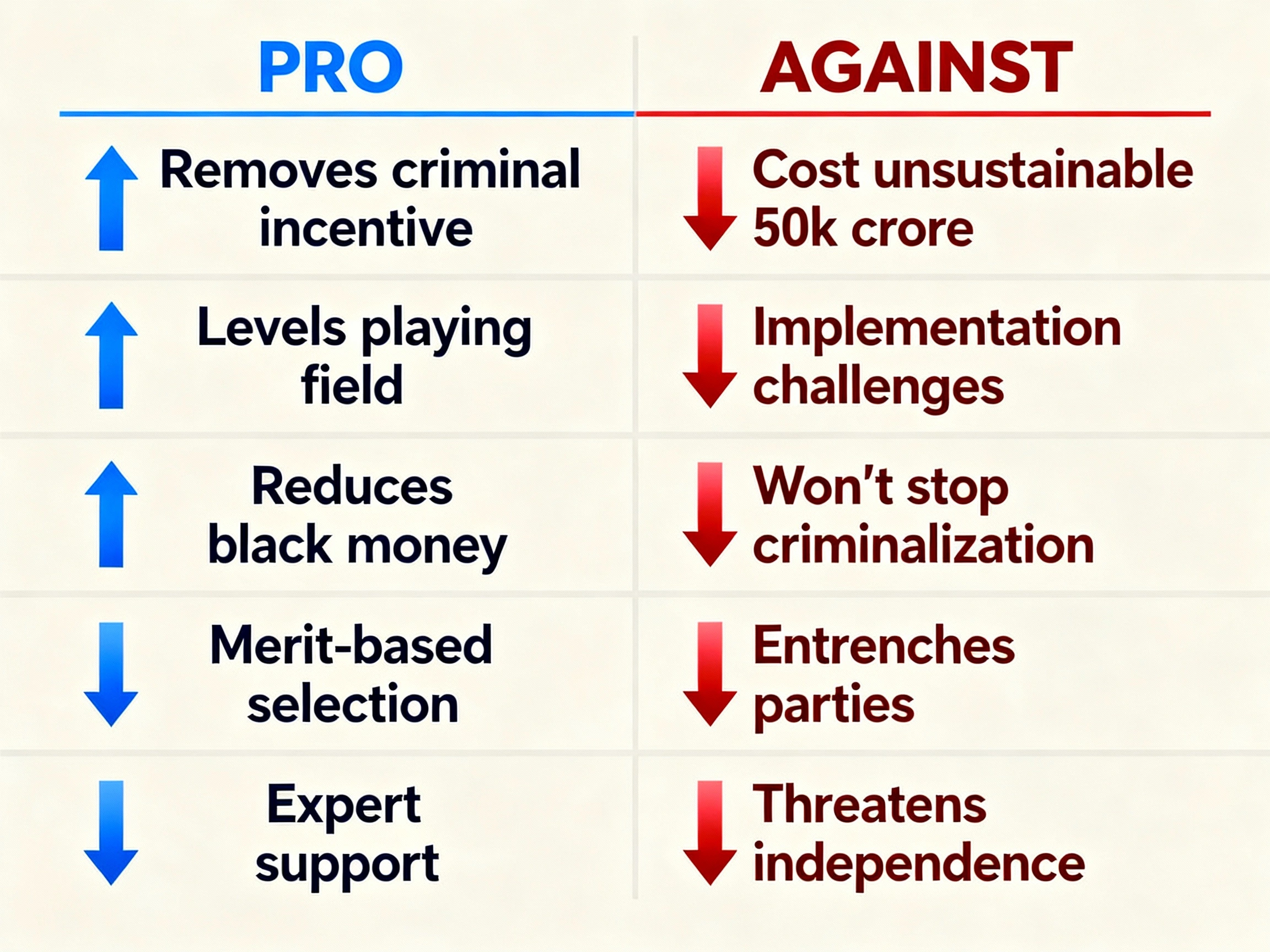
The national elections cost in India is about ₹10,000-15,000 crores and State elections cost another ₹30,000-40,000 crores. It’s about total ₹50,000 crores for a 5-year electoral cycle.
That’s money diverted from health, education, infrastructure. Real impact of it would be a country with 50% of population living on <$2 per day, high maternal mortality rate, and limited access to rural healthcare. Diverting ₹50,000 crores to state-funded elections seems ethically questionable.
Argument 2: Implementation Challenges Are Massive
Determining the eligibility for state funding is a tough task. Who gets state funding? Would it be only national parties or only registered parties? What about independent candidates and new parties challenging the status quo? Without clear criteria, this benefits only to the established parties which will perpetuate the status quo.
Another problem is about the allocation formula. Should all parties get equal funds or should it be based on previous vote share? Should it be per candidate, per state, or per national/state party?
The monitoring of the expenditure is impossible. Even with state funding, can’t prevent the private donations. How do we prevent dual funding (state + private)? It requires enforcement of separate audit bodies, regular inspections, strong penalties, etc.
Argument 3: Won’t Actually Stop Criminalization
State funding assumes money is the primary reason criminals dominate politics. But, money is one factor among several. The other reasons behind the criminalization of politics are;
- Slow justice system: Criminal trials take 10-15 years. A criminal becomes minister/CM long before facing judgment.
- Weak conviction rates: Only 1-2% of criminal charges against politicians lead to conviction.
- Political party strategy: Parties choose criminals because they WIN elections, not just because they fund campaigns.
- Voter behavior: In some regions, voters elect the candidates with criminal records (perceiving them as “strong”).
Example: In India, some constituencies consistently elect candidates with serious criminal charges. Money aside, cultural factors and perception of “strength” drive voter choice.
Argument 4: May Actually Entrench Established Parties
In real, state funding benefits whoever is already established in the politics. Big parties have infrastructure to maximize funds but new parties struggle to meet eligibility criteria. The real risk is where a ruling government could deny state funding to opposition parties (arbitrary criterion), and conduct audits targeting specific parties, or implement “compliance checks” that are actually harassment.
Is State Funding of Elections Feasible in India?
Yes, state-funded elections are feasible, if strong monitoring institutions exist with digital tracking. Criminal cases must lead to immediate disqualification of candidature.
If the administrative machinery is overstretched in a multi-level elections. It makes implementation complex and costly. Thus, India may not be ready for full-scale public funding, but partial funding paired with strict reforms is achievable.
Can State-Funded Elections Curb the Criminalization of Politics in India?
The criminalization of politics is a slow-motion coup against democracy. Every year, more criminals enter legislatures. Every year, the politician-criminal nexus strengthens. State funding of elections has the potential to reduce criminalization of politics, enhance transparency, and create a more level playing field.
But it’s not a silver bullet. Without enforceable regulations, transparency, and political will, public funding alone won’t solve deep-rooted structural issues. The path forward is comprehensive reform:
Start with justice system and institutional strengthening and gradually reduce private funding dependency. Build state funding infrastructure carefully and engage citizens. State funding should be viewed as one piece of a much larger puzzle, not the complete solution.
Should There Be State Funding of Elections?
The question before us is not whether state funding would be perfect. It’s whether it’s better than the current system. Today, 24% of MPs have criminal records. That’s not coincidence; that’s because criminals have money and guns, and money is the oxygen that fuels election campaigns. By providing equal state funding, we remove that oxygen.
We make politics competitive on ideas, not on illegal resources. Yes, there are implementation challenges. Yes, costs are high. But the cost of having criminals in parliament is HIGHER—in corruption, in rule of law degradation, in lost democratic integrity. We’re not saying state funding is the complete solution. We’re saying it’s a necessary component of comprehensive reform. And every expert committee on electoral reform agrees.
Prepare for CAT GDPI Topics
Now, that you have crossed the first hurdle of cracking the CAT exam, it’s time to focus on the next stage. It’s about preparing for Group Discussion (GD), Written Ability Test (WAT) & Personal Interview (PI) round from the IIMs and other prestigious B-Schools like XLRI, FMS, MDI, SP Jain, NMIMS and SIBM.
Click to Prepare for GDPI Round
During the GD-WAT-PI selection process, you compete with the best of the best and it is but natural that you would want to be coached by the leading experts in the field of Personality development and GDPI training.
Learn more, How to Prepare for CAT GDPI Topics