

SLAT Exam Pattern: Syllabus, Best Books and more
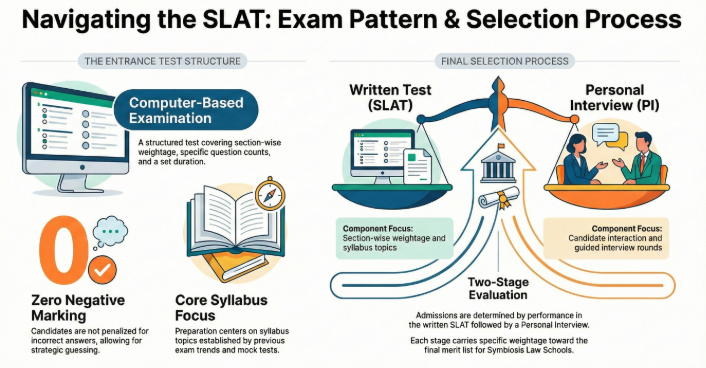
Understanding the SLAT exam pattern is essential for aspirants as it covers section-wise weightage, number of questions, marking scheme, exam mode, time duration, and the absence of negative marking. In addition to the written test structure, the SLAT selection process also includes a Personal Interview (PI) stage, with clearly defined weightage for each stage. This blog provides a complete overview of the SLAT 2027 exam pattern, including stage-wise weightage, syllabus topics based on previous trends, preparation tips, the role of mock tests, and guidance for the PI round, helping candidates plan their preparation in a structured and informed manner.
SLAT Exam Pattern: Section-wise Weightage
Here are the critical points of the paper pattern for SLAT 2027.
| Section | No. of Questions | Marks |
| Logical Reasoning | 12 | 12 |
| Legal Reasoning | 12 | 12 |
| Analytical Reasoning | 12 | 12 |
| Reading Comprehension | 12 | 12 |
| General Knowledge | 12 | 12 |
| Total | 60 | 60 |
| Time Duration | 60 minutes | — |
- Each question carries 1 mark.
- No negative marking.
- The SLAT 2027 exam will be computer-based.
- It is a national-level exam with a 60-minute duration.
- The test will be conducted entirely in English and will cover subjects such as Logical Reasoning, Legal Reasoning, Analytical Reasoning, Reading Comprehension, and General Knowledge.
- The SLAT paper format consists of multiple-choice questions.
Know more: SLAT 2027 – Exam Dates, Registration, Syllabus, Pattern, Preparation Tips
Stage-wise SLAT Weightage
Here is the table of the weightage of different stages:
| Screening Stage | Weightage (Marks) |
| SLAT Scores | Converted on a scale of 70 |
| Personal Interview | 30 |
| Total marks | 100 |
SLAT Selection Process 2027
The SLAT exam pattern 2027 encompasses two stages:

- SLAT Entrance Exam: The first stage involves the primary examination, the SLAT itself. This test evaluates your abilities across various sections like Logical Reasoning, Legal Reasoning, Analytical Reasoning, Reading Comprehension, and General Knowledge. It serves as the initial screening process, evaluating your skills relevant to law studies.
- Personal Interview (PI): The final stage of the SLAT Exam Pattern involves the Personal Interview (PI). Here, you face a panel of interviewers who delve deeper into their personalities, motivations, aspirations, and suitability for a legal education and career. Know more: SLAT Application form – Form filling guidelines
SLAT exam pattern 2027: Highlights
Does SLAT have any negative marking? SLAT is of how many marks? Get the answer to all these questions.
As per the SLAT exam pattern, check out the table below to understand the SLAT pattern:
| Particular | Details |
| Level | National |
| SLAT Exam Mode | CBT (Computer Based Test) |
| Mode of Instructions | English |
| Sections of Questions | 5 sections (Reading Comprehension, Logical Reasoning, Analytical Reasoning, Legal Reasoning, General Knowledge) |
| Kinds of Questions | Multiple Choice Questions |
| Total Number of Questions | 60 |
| SLAT Total Marks | 60 |
| Section-wise Questions | 12 in each section |
| SLAT Time Duration | 1 Hour (80 Minutes for Differently Abled) |
| Marks For Correct Answer | 1 Marks |
| SLAT Negative Marking | No |
Read More – SLAT Cutoff – Expected SLAT cutoffs for all SLS campuses
Register now for the SLAT free mock test. Sharpen your skills, boost your confidence for the SLAT, and take an unfair advantage by signing up today!
SLAT Syllabus 2027 (Important Topics)
While official information suggests the exam pattern of SLAT and lacks a detailed subject syllabus, an analysis of previous exam papers has aided in structuring the below important topics of the SLAT exam syllabus:
| Sections | SLAT Important Topics |
| Logical Reasoning | Puzzles, deriving inferences and conclusions from arguments, syllogisms |
| Legal Reasoning | Legal aptitude, fundamental rights, basic legal terms, important laws and acts |
| Analytical Reasoning | Analyzing patterns in given data by performing basic mathematical operations like addition, subtraction, etc. |
| Reading Comprehension | Vocabulary, grammar fundamentals (tenses, conjunctions, prepositions), sentence improvement, reading skills |
| General Knowledge | Recent national and international events in current affairs |
SLAT Exam Preparation Tips
- Start early: Begin your SLAT preparation well in advance to allow sufficient time for thorough review and practice.
- Understand the exam format: Familiarize yourself with the format, structure, and question types of the SLAT exam.
- Invest in quality resources: Use reputable SLAT prep materials, such as official practice tests and study guides.
- Develop a study plan: Create a structured study plan outlining daily and weekly goals leading up to the exam.
- Focus on fundamentals: Build a strong foundation in fundamental concepts tested on the SLAT, such as logical reasoning and reading comprehension.
- Practice regularly: Dedicate consistent time to practice SLAT questions and mock tests to hone your skills.
- Prioritize weak areas: Identify your weakest areas and allocate extra time and resources to strengthen them.
Prepare for SLAT Exam through Mock Tests
SLAT is about accuracy under time pressure. That’s why mock tests and their analysis are the most essential part of your preparation.
What Makes IMS SLAT Mocks Stand Out?
IMS Mock tests are designed by expert mentors while maintaining the following points:

- Exam-interface accuracy
- Sectional time tracking
- Post-test detailed analysis with strategy
- All-India ranking for benchmarking
Tip: Maintain a “mistake logbook/analysis copy” and note recurring errors.
PI Preparation After SLAT
You can expect these questions in the PI round after SLAT exam.
- Questions about yourself, academics, goals, law awareness.
- “Why Law?”, “Why SLS?”, “What are your strengths?”
- Current legal issues or opinions on trending topics.
How to Prepare for Personal Interview after SLAT?
- Practice mock interviews.
- Read newspapers/editorials daily.
Conclusion
The SLAT exam pattern 2027, which comprises computer-based testing, encompasses a two-stage selection process: the entrance exam and the Personal Interview (PI). This blog is about the SLAT exam pattern 2027, which includes the syllabus, the marking scheme, the type of questions, section-wise weightage, the best books for preparations & more.