

CAT Exam Pattern 2026: Check CAT Paper Pattern, Total Marks & Marking Scheme
Table of Contents
What is the CAT Exam Pattern 2026?
Overview of CAT Exam Pattern 2026
Quantitative Aptitude – CAT Exam Pattern 2026
VARC – CAT Exam Pattern 2026
DILR – CAT Exam Pattern 2026
Key Points to Keep in Mind for the CAT Exam 2026
Evolution of CAT Exam Pattern Over the Years
CAT Exam Pattern 2026: Conclusion
Key Highlights
✔️ CAT 2026 is expected to follow the CAT pattern with 68 questions across VARC, DILR, and Quantitative Aptitude, carrying a total of 204 marks.
✔️ The exam duration is 120 minutes, with a strict sectional time limit of 40 minutes for each section.
✔️ VARC contains 24 questions, while DILR and Quantitative Aptitude have 22 questions each, including both MCQ and TITA formats.
✔️ The marking scheme awards +3 marks for every correct answer and deducts -1 mark for every incorrect MCQ response.
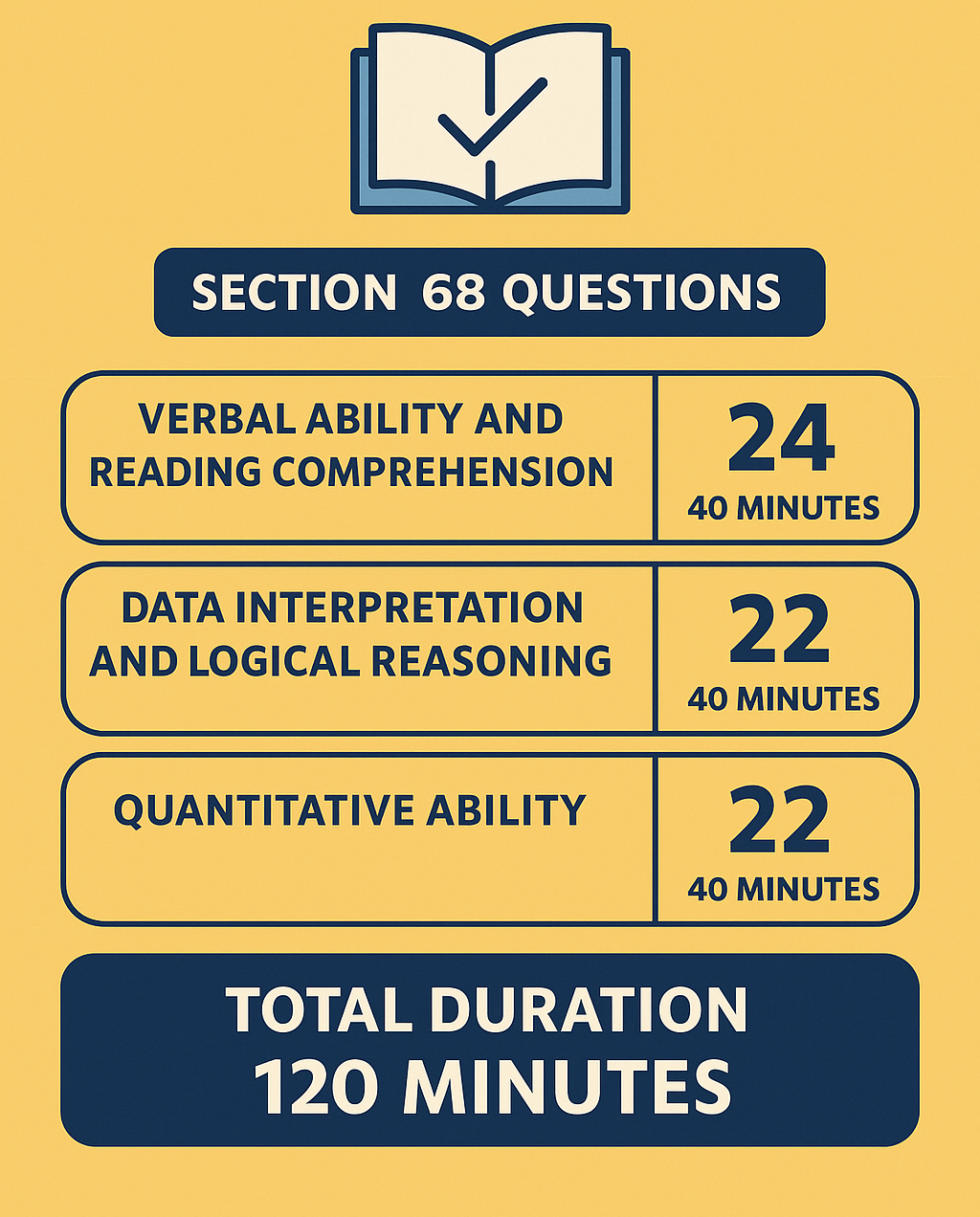
CAT Exam Pattern 2026: The CAT 2026 exam will likely have three sections: Verbal Ability & Reading Comprehension (VARC), Data Interpretation & Logical Reasoning (DILR), and Quantitative Ability (QA), with a total of 68 questions. VARC will have 24 questions worth 72 marks, while DILR and QA will have 22 questions each, worth 66 marks each. The exam includes both Multiple Choice Questions (MCQs), which have negative marking (−1 for wrong answers, +3 for correct), and Non-MCQs/TITA questions, which do not have negative marking (+3 for correct). The test is computer-based, lasts 2 hours (40 minutes per section with strict timing), and is conducted in English.
CAT Exam Pattern 2026 – Latest Changes in the Exam Pattern
- CAT 2026 will likely keep the 68-question format first used in CAT 2024. The exam has three sections: VARC, DILR, and QA. You will get 2 hours in total, with 40 minutes for each section.
- The biggest recent change happened in CAT 2024, when the total questions went up from 66 to 68 and the DILR section grew from 20 to 22 questions.
- If you are preparing for CAT 2026, expect a moderately tough paper. Focus on being accurate and managing your time well. Remember, score-to-percentile cutoffs can change, so use them as a guide, not a rule.
Read More: CAT Exam 2025: Date, Registration, Eligibility, Pattern, Syllabus, Preparation Tips, Cutoff
What is the expected CAT Exam Pattern 2026?
The organisation that administers the CAT also notifies of the exam pattern annually. The exam pattern focuses on the evaluation of a candidate’s aptitude for resolving mathematical and reasoning problems. According to the pattern, there are three exam portions: DILR, VARC, and QA.
- The CAT VARC section with 24 questions and a weightage of 72 marks.
- The CAT DILR section with 22 questions and a weightage of 66 marks.
- The CAT Quantitative Aptitude section with 22 questions and a weightage of 66 marks.
Read More – CAT Syllabus: Sections, Weightage, Exam Pattern, Tips to Prepare
Overview of CAT Exam Pattern 2026
CAT exam has a total of 68 questions and a total examination time of 120 minutes, with a 40-minute sectional time limit. According to the CAT exam pattern, officials can quickly assess a candidate’s logical and mathematical abilities. Candidates who intend to take future exams should become familiar with the CAT exam pattern.
Expected CAT Exam Pattern 2026 & Exam Mark Distribution
Here is a detailed analysis of the latest CAT marks distribution based on last year’s exam pattern:
| Section | MCQs | Non-MCQs | Total No. of Questions | CAT Exam Duration |
| Verbal Ability and Reading Comprehension (VARC) | 22 | 2 | 24 | 40 min |
| Data Interpretation and Logical Reasoning (DI & LR) | 12 | 10 | 22 | 40 min |
| Quantitative Ability (QA) | 14 | 8 | 22 | 40 min |
| Total | 48 | 20 | 68 | 120 (2 hours) |
Read More – CAT Previous Years’ Papers – Click here to take CAT in test format
CAT Exam Pattern 2026: CAT Exam Duration
CAT sections have a fixed time limit. The following are the sectional timings and slot-by-slot information for the most recent CAT Exam Pattern:
| CAT Exam Sections | CAT Sectional Time |
| VARC | 40 minutes |
| QA | 40 minutes |
| DILR | 40 minutes |
| Total | 120 minutes |
Read More – MBA from IITs – Admission, eligibility, fees, placements |
Quantitative Aptitude – CAT Exam Pattern 2026
CAT Quantitative Aptitude consists of numerically based questions drawn from a range of math topics. In the current pattern, this section has 22 questions, and CAT 2026 is expected to continue with the same structure.
Here’s a clean table for CAT 2025 slot-wise weightage based on the section-wise pattern reported in CAT 2025 analyses. The overall paper had 68 questions: VARC 24, DILR 22, and QA 22, with section weightage of about 35%, 32%, and 32% respectively.
CAT 2025 slot-wise weightage
| Arithmetic | Algebra | Geometry | Modern Math |
| Percentages | Linear Equations | Lines and Angles | Permutations and Combinations |
| Ratio and Proportion | Quadratic Equations | Triangles | Probability |
| Averages and Mixtures | Inequalities | Circles | Set Theory |
| Profit, Loss, and Discount | Functions | Quadrilaterals | Venn Diagrams |
| Simple and Compound Interest | Logarithms | Polygons | Binomial Theorem |
| Time, Speed, and Distance | Progressions (AP, GP, HP) | Mensuration (2D and 3D) | Functions and Graphs |
| Time and Work | Sequences and Series | Coordinate Geometry | |
| Pipes and Cisterns | Maxima and Minima | Trigonometry | |
| Boats and Streams | Polynomials | Similarity of Triangles | |
| Partnerships | Properties of Circles |
Number System:
| Numbers |
| Number System:
Natural Numbers, Whole Numbers, Integers Rational and Irrational Numbers Real Numbers |
| Divisibility and Remainders |
| Factors and Multiples |
| HCF and LCM |
| Prime Numbers and Composite Numbers |
| Cyclicity and Factorials |
| Base System |
| Indices and Surds |
Read More – CAT Exam 2026: Date, Registration, Eligibility, Pattern, Syllabus, Preparation Tips, Cut Off | MBA vs PGDM – Which one is better?
Marks distribution graph of Quantitative Aptitude topics:
Below is the marks distribution graph of quantitative aptitude question distribution based on the 2025 CAT exam pattern:
- 11–12 questions were from arithmetic and algebra, making them the core focus areas.
- CAT 2025 also included a mix of MCQs and TITA questions in Quant, with TITA questions continuing to carry no negative marking.
- The CAT quantitative aptitude section was generally reported as moderate to difficult.
Read More – CAT Score vs Percentile 2025 – Section-wise analysis of CAT scores and percentiles.
VARC – CAT Exam Pattern 2026
This evaluates candidates on their English language skills, their ability to interpret paragraphs, and their understanding of the core ideas. CAT 2025 had 24 questions in VARC, and CAT 2026 is expected to follow the same pattern.
In CAT 2025, the VARC section included TITA (type-in-the-answer) questions with no answer options, requiring candidates to type their responses. Besides, analysts reported that the difficulty level of both the reading comprehension and verbal ability parts of VARC has been trending upward.
Read More – CAT Cutoff – Find out CAT cutoffs for IIMs and other top colleges.
Reading Comprehension:
| Reading Passage Type | Weightage |
| Descriptive Passages | Less |
| Narrative Passages | Less |
| Argumentative Passages | Most |
| Analytical Passages | Most |
| Abstract Passages | Less |
Types of RC Questions:
| Main Idea |
| Inference-based |
| Specific Details Questions |
| Tone, Style, and Source |
| Application Questions |
| Logical Structure |
Verbal Ability:
| Verbal Ability Question Types |
| Para-jumbles |
| Para-summary |
| Odd-one-out |
| Para-completion |
Read More – CAT Exam Eligibility Criteria 2026
DILR – CAT Exam Pattern 2026
CAT DILR section evaluates the candidates’ ability to interpret data and understand logical assumptions.
The questions will vary from inequalities to symbol operations, direct sense tests, etc. Besides, this section’s questions are easily solvable, and hence, they let you score higher.
Interpreting the data is difficult and time-consuming. However, candidates should be able to comprehend the data sets thoroughly so that they can answer the full set of questions. Meanwhile, data interpretation on the CAT should be conducted cautiously, as a single mistake may result in candidates incorrectly attempting all questions from each set.
Data Interpretation:
| Data Interpretation – Types of Graphs | Key Concepts in DI | Logical Reasoning |
Key Concepts in LR |
| Bar graphs | Percentages and Ratios | Seating Arrangements | Deductive Reasoning |
| Pie charts | Averages and Weighted Averages | Blood Relations | Inductive Reasoning |
| Line graphs | Profit and Loss | Direction Sense | Critical Thinking |
| Venn diagrams | Growth Rates | Syllogisms | Problem-Solving |
| Caselets | Data Comparison | Clocks and Calendars | |
| Combination of multiple graphs | Coding-Decoding | ||
| Number Series | |||
| Logical Sequences | |||
| Puzzles | |||
| Games and Tournaments |
Key Points to Keep in Mind for the CAT Exam 2026
- The exam is a computer-based test.
- The use of an onscreen calculator allows for computation during the exam.
- CAT is conducted in multiple slots, but each candidate takes only one 2-hour test
- The CAT 2025 exam carried a total of 204 marks. Note that candidates cannot switch between sections during the test, so plan your time and strategy accordingly.
- The onscreen clock will help candidates to keep a tab on the time during the exam.
- For each incorrect answer in MCQs, 1 mark will be deducted.
- The sheets of paper are provided for rough work. As soon as the exam is over, they must be submitted to the exam centre.
- Candidates cannot start their tests before the time is up and can only log in after the invigilator announces it.
Read More – Top MBA Colleges in India
Evolution of CAT Exam Pattern Over the Years
CAT exam patterns have been modified several times over the years.
Below is a table that provides an overview of how it has evolved over time.
| Year | Number of Questions | Difficulty Level | CAT exam time duration | Conducting Body |
| 2024 | 68 | Easy to moderate | 2 hours | IIM Calcutta |
| 2022 | 66 | Moderate | 2 hours | IIM Bangalore |
| 2021 | 66 | Moderate to High | 2 hours | IIM Ahmedabad |
| 2020 | 76 | Moderate to High | 2 hours | IIM Indore |
| 2019 | 100 | Moderate to High | 3 hours | IIM Kozhikode |
| 2018 | 100 | Moderate to High | 3 hours | IIM Calcutta |
| 2017 | 100 | Moderate | 3 hours | IIM Lucknow |
| 2016 | 100 | Moderate to difficult | 3 hours | IIM Bangalore |
| 2015 | 100 | Moderate to difficult | 3 hours | IIM Ahmedabad |
| 2014 | 100 | Moderate to Easy | 2.50 hours | IIM Indore |
| 2013 | 60 | Moderate to Easy | 2:20 hours | IIM Indore |
| 2012 | 60 | Moderate to Easy | 2.20 hours | IIM Indore |
| 2011 | 60 | Moderate | 2.20 hours | IIM Calcutta |
Read More: CAT vs XAT
CAT Exam Pattern 2026: Conclusion
CAT is a computer-based test (CBT) divided into 3 sections of 68 questions: VARC, DILR, and QA. Each section will have 40 minutes. Meanwhile, the exam paper will have MCQ and TITA, and most questions will be MCQ-based. This guide on CAT paper patterns will help the CAT aspirants to get familiar with the latest patterns and prepare accordingly.
How many sections will be there in CAT 2026?
The CAT 2026 will have three sections:
a. Section 1: Verbal Ability and Reading Comprehension
b. Section 2: Logical Reasoning and Data Interpretation
c. Section 3: Quantitative Ability
What is the marking scheme for the CAT exam?
According to the CAT exam marking scheme, the candidates will get +3 for every correct answer. Furthermore, each incorrect answer will result in a deduction of -1.
According to the CAT exam pattern, how many non-MCQs are in each section?
The IIMs have provided no information regarding the number of non-MCQ questions. However, the number may differ depending on the section and the year.