
How Should Commerce and Arts Students Prepare for IPMAT 2026? A Practical, Stream-Specific Guide

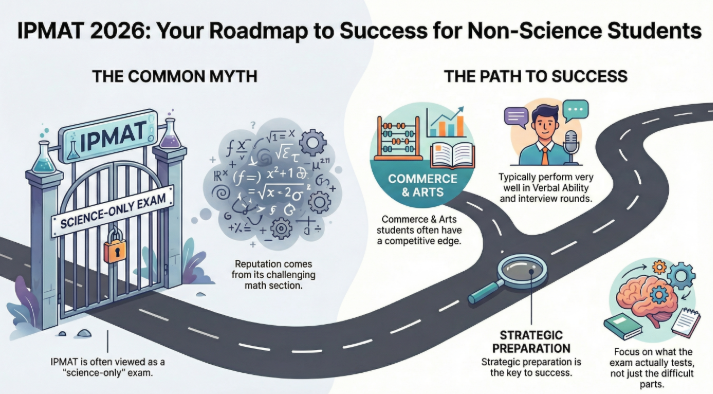
Many people believe the Integrated Programme in Management Aptitude Test (IPMAT) is just for science students since it is known for its math section. But Commerce and Arts students often perform well, especially in Verbal Ability and interviews.
If you come from a Commerce or Arts background, you can succeed in IPMAT 2026 as long as you prepare for what the exam actually tests.

This guide will help you know what to focus on, what to skip, and how to prepare well as a non-science student.
Understanding IPMAT from a Commerce & Arts Perspective
IPMAT mainly checks your aptitude, not advanced math or technical knowledge.
IPMAT Sections (IIM Indore Pattern)
- Quantitative Ability (MCQ)
- Quantitative Ability (Short Answer)
- Verbal Ability
No science concepts. No calculus. Trigonometry (X level)
This helps make the exam fair for students from Arts, Humanities, and Commerce backgrounds.
Your Natural Strengths as a Commerce or Arts Student
Before you begin studying, take a moment to notice your natural strengths:

Verbal Ability Is Your Strong Zone
Commerce and Arts students usually excel in:
- Reading Comprehension
- Vocabulary
- Grammar
- Logical sentence formation
This part of the exam can really help you raise your overall score.
Conceptual Thinking
IPMAT math focuses on:
- Logic
- Interpretation
- Arithmetic reasoning
It does not focus on memorized formulas, which means non-science students can compete on equal footing.
Interview Readiness
Arts and Commerce students often perform better in:
- Personal Interviews
- Abstract thinking questions
- Opinion-based discussions
- Awareness of society, business, and current affairs
Biggest Mistake Commerce & Arts Students Make
- Trying to prepare like Science students
- Over-fearing Quantitative Ability
- Starting preparation too late due to “math anxiety”
IPMAT math is at the level of Class 9 or 10 arithmetic, not as advanced as JEE-level math.
How to Prepare for Quantitative Ability
Quantitative Ability (Short answers)
Topics You Must Master
|
|
|
|
|
|
|
|
|
|
|
Quantitative Ability (MCQ)
| Topics you must master |
|
|
|
|
|
|
|
|
|
|

These topics cover a large part of the questions in IPMAT.
How to Study Quant Effectively
- Begin by understanding the concepts, not just shortcuts
- Use visual explanations and step-wise logic
- Practice short answer questions carefully (no options to guess)
- Focus on accuracy over speed initially
You don’t need advanced math for this exam. What matters most is staying disciplined and consistent in your studies.
Verbal Ability Strategy: Turn It into Your Strength
Commerce and Arts students often score higher than others in this section.
What to Focus On
- Reading Comprehension (daily reading habit)
- Vocabulary in context (not word lists)
- Grammar usage, not rules memorisation
- Para jumbles and sentence logic
Daily Verbal Routine
- Read editorials or long articles
- Solve RC passages under the time limit
- Learn words through usage, not rote learning
Aim to be as accurate as you can in the Verbal Ability section.
Daily Study Plan for Commerce & Arts Students (School Friendly)
Weekdays
- Quantitative Aptitude: 60–75 mins
- Verbal Ability: 45 mins
- Revision / practice questions: 30 mins
Weekends
- Full-length mock or sectional test
- Spend time analyzing your performance in detail, as this is more important than just looking at your score.
- Revision of weak topics
Importance of Mock Tests for Non-Science Students
Mock tests are not just practice exams; they also help build your confidence.
After every mock, ask:
- Was the mistake conceptual or careless?
- Did I panic on math questions?
- Did I rush verbal questions unnecessarily?
You improve by analyzing your mock tests, not just by taking more of them without reflection.
Interview & Profile Preparation Advantage
Commerce and Arts students should prepare early for:
- “Why IPM?”
- “Why management after Arts/Commerce?”
- Current affairs (business + society)
- Personal opinions with logical backing
Your academic background is not a weakness. In fact, it can be a strength if you explain it well.
When Should You Start Preparing for IPMAT 2026?
- Class 11 students: Start now, light but consistent
- Class 12 students: Immediate structured preparation
- Droppers: Strong focus on mocks + weak areas
Even 8 to 10 months of focused preparation is enough.
Final Truth: Can Commerce & Arts Students Crack IPMAT?
Yes, and they do, every year.
IPMAT rewards:
- Clear thinking
- Language skills
- Basic numerical reasoning
- Calm execution
Conclusion
If you are a Commerce or Arts student targeting IPMAT 2026, your success depends on:
- Removing fear of Quantitative Ability
- Maximising Verbal Ability scores
- Practising consistently, not excessively
- Trusting your strengths instead of copying others
IPMAT is not about who studied science.
It’s about who prepared smartly.
FAQs: How should Commerce and Arts students prepare for IPMAT 2026
Can Commerce students crack IPMAT 2026 without a science background?
Yes. IPMAT tests aptitude, not science knowledge. Commerce students perform well due to strong verbal skills and logical thinking, which are key components of the exam.
Is IPMAT math difficult for Arts students?
No. IPMAT quantitative questions are based on Class 9–10 arithmetic, logic, and reasoning. With consistent practice, Arts students can comfortably handle this section.
What is the best IPMAT preparation strategy for non-science students?
The best strategy is to focus on concept-based arithmetic, strengthen verbal ability, take regular mock tests, and analyse mistakes instead of memorising formulas.
How should Commerce and Arts students balance Quant and Verbal for IPMAT?
Non-science students should maximise Verbal Ability scores while steadily improving Quant accuracy. Verbal can act as a score booster if prepared consistently.
How many hours should Commerce or Arts students study daily for IPMAT 2026?
A focused 2.5–3 hours on weekdays and mock-based practice on weekends is sufficient if preparation is consistent and well-structured.
When should Arts and Commerce students start preparing for IPMAT 2026?
Class 11 students should start light preparation early, Class 12 students should begin structured prep immediately, and droppers should focus heavily on mocks and weak areas.
Do Commerce and Arts students have an advantage in IPMAT interviews?
Yes. They often perform well in interviews due to better articulation, abstract thinking, awareness of current affairs, and clarity of opinions.
Is IPMAT preparation different for Commerce, Arts, and Science students?
Yes, Commerce and Arts students should prioritise verbal ability, reduce math anxiety, and focus on accuracy and interpretation rather than speed or advanced math.

Tags