
IPMAT Syllabus 2026: Section-wise Syllabus, IIM (Indore & Rohtak)

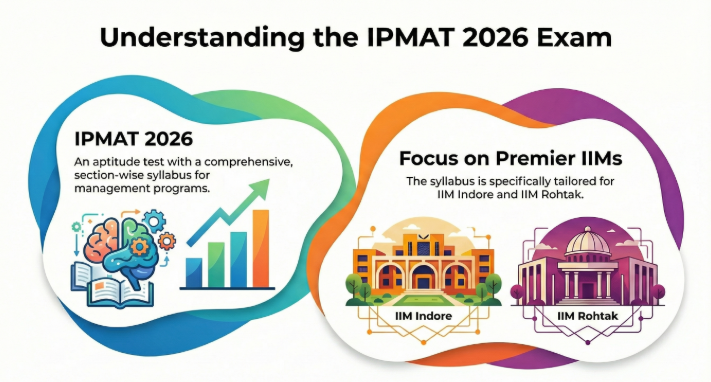
Update: The IPMAT 2026 exam, conducted for admission into prestigious institutes like IIM Indore and IIM Rohtak, is scheduled for May 4, 2026. To crack this highly competitive exam, understanding the IPMAT syllabus 2026 in a detailed and structured manner is essential.
In this guide, we break down the IPMAT Indore and IPMAT Rohtak syllabus, section-wise topics, weightage, and preparation strategy to help you build an effective study plan.
What is IPMAT Syllabus 2026?
The IPMAT syllabus 2026 includes three major sections: Quantitative Ability, Verbal Ability, and Logical Reasoning (for Rohtak), covering topics like arithmetic, algebra, reading comprehension, grammar, and data interpretation.
IPMAT Syllabus 2026: IPMAT Indore
The following are details about the IPMAT syllabus for IIM Indore:
Quantitative Ability
The following table shows the important topics under the IPMAT Syllabus for the Quantitative Ability section.
| Topic | IPMAT Syllabus: Sub-Topics | ||
| Number System | Remainder | HCF & LCM | Properties of a Number |
| Factorial | Finding Unit Digit | Surds & Indices | |
| Successive Division | Divisibility | Simplification | |
| Concept of Factor | |||
| Algebra | Algebraic Formulae | Linear Equations | Inequalities |
| Quadratic Equations | Logarithm | Functions & Graphs | |
| Geometry | Basics of Geometry | Angles | Lines |
| Triangles | Quadrilaterals | Circle | |
| Polygons | Coordinate Geometry | Mensuration | |
| Height & Distance | |||
| Arithmetic Problems | Time & Work | Average | Problems on Age |
| Percentage | Partnership | Profit Loss & Discount | |
| Ratio & Proportion | Simple & Compound Interest | Mixture & Allegations | |
| Time, Speed & Distance | Boats & Streams | – | |
| Modern Maths | Set theory | Probability | Permutation & Combination |
| Sequence & Series | Determinants | Integration & Differentiation | |
| Determinants | Data Interpretation | Vectors | |
Watch This Video on IPMAT Syllabus and Paper Pattern:

Verbal Ability
The table below shows the important topics under the IPMAT Syllabus for the Verbal Ability section.
| Syllabus of IPMAT – Topic | IPMAT Syllabus: Sub-Topics | ||
| Vocabulary | Synonyms | Antonyms | Spelling Errors |
| Idioms & Phrases | One Word Substitution | Odd one out | |
| Foreign Words | Word Usage | ||
| Grammar | Noun | Pronoun | Prepositions |
| Verb | Adverb | Conjunctions | |
| Direct & Indirect Speech | Figures of Speech | Phrasal Verbs | |
| Tenses | Etymology & Roots | Articles | |
| Active Voice | Passive Voice | Deductive Reasoning | |
| Subject-Verb Agreement | |||
| Verbal Ability | Error Spotting | Fill in the blanks | Sentence Completion |
| Para jumbles | Sentence Improvement | Analogies | |
| Reading Comprehension | Synonym & Antonym (the meaning of a particular word used in the passage) | Inference based questions | Assumption based questions |
Read More: IPMAT Paper Pattern
IPMAT Syllabus 2026: IPMAT Rohtak
The following are details about the syllabus:
Quantitative Ability
This table provides insights that will help you learn about topics likely to appear in this section, allowing you to prepare accordingly.
| Number systems | Common graphs & charts | Data Interpretation | Mixtures and Allegations |
| Distance, Time, and Work | Averages | Quantitative reasoning | Geometry |
| Profit & Loss | Simple Equations | Percentages | Quadratic Equations |
| Binomial Theorem | Mensuration | Permutation & Combination | Ratio & Proportion |
| Trigonometry | Set Theory | Problems on Ages | Logarithms |
Read More – IPMAT Indore Selection Process

Logical Reasoning
This table will help you better understand the topics you need to focus on while preparing for the logical reasoning section.
| Syllabus for IPMAT – Topic | IPMAT Syllabus: Sub-Topic |
| Basic LR | Logical Sequence Series, Coding, Arrangements
Blood Relations, Input & Output, Binary Logic |
| Standard LR Sets | Games and Tournaments, Cubes and Visual Puzzles, Word Problems,
Sequencing, Grid Puzzles, Linear and Circular Seating Arrangements, etc |
| Visual Puzzles | Cubes and Dices, Venn Diagrams |
| Sentence Correction | Critical Reasoning, Statements, Conclusions, Syllogisms, True or False, etc. |
Verbal Ability
The verbal Ability Syllabus has different topics, such as grammar, vocabulary, reading comprehension, and critical reasoning. A strong understanding of these areas can significantly improve your performance in the exam. Therefore, it is important to study and prepare thoroughly for this section of the exam.
| Vocabulary (including Synonyms and antonyms) | Reading Comprehension | Grammar | Sentence Rearrangement |
| Sentence Correction | Sentence Completion | Correct Usage of words and phrases | Verbal Analogies |
| Logical Consistency | Deductive Reasoning | Inference based passages | Prepositions |
| Conjunctions | Tenses | Modifiers & Parallelism | Noun & Pronoun Errors |
Also, Read: IPMAT Rohtak Syllabus In Detail
IPMAT Indore Syllabus 2026: Section-Wise Weightage
Here is the section-wise weightage of important questions and topics of the IPMAT exam 2026.
Quantitative Ability (QA) (Short Answer)
Below is the breakdown of the important questions and topics based on analysis from past papers.
| Topic | Number of Questions |
| Numbers, Fractions, Remainders, HCF, LCM | 1 |
| Arithmetic, %, P and L, Ratios, Averages | 3 |
| Geometry, Trigonometry, Coordinate, Conic Section | 3 |
| Logarithms, Surds and Indices | 1 |
| Linear and Quadratic Equations, Inequalities | 3 |
| Functions and Graphs, progression and Binomial | 1 |
| Determinant | 1 |
| Statistics – Median | 3 |
| Total | 15 Q |
Read More – IPMAT Indore Exam Pattern
Quantitative Ability (MCQ)
Below is the breakdown of the important questions and topics.
| Topic | Number of Questions |
| LR / DI | 5 |
| Numbers, Fractions, Remainders, HCF, LCM | 1-2 |
| Arithmetic, %, P and L, Ratios, Averages | 2-3 |
| Arithmetic – Time Speed Distance and Time and Work | 1-2 |
| Geometry, Trigonometry, Coordinate | 6-7 |
| Logarithms, Surds and Indices | 2-3 |
| Linear and Quadratic Equations, Inequalities | 2-3 |
| Functions and Graphs, progression and Binomial | 2-3 |
| Set Theory, Probability and P and C | 2-3 |
| Matrices and Determinants | 1 |
| Total | 30 Q |
Verbal Ability
Below is the breakdown of the important questions and topics.
| Topic | Number of Questions |
| Reading Comprehension | 12 |
| Fill in the Blanks | 4 – 5 |
| Idioms and Phrases | 8 |
| Para Completion | 5 – 6 |
| Correct the underlined part | 5 – 6 |
| Para Jumbles (TITA) | 5 |
| Incorrect word Usage | 5 |
| Total | 45 Q |
IPMAT Rohtak Syllabus: Section-Wise Weightage
Quantitative Ability
Below is the breakdown of the important questions and topics.
| Topic | Number of Questions |
| Percentage, Profit and Loss, SI and CI | 8 – 10 |
| Ratios, Averages and Mixtures | 5 – 6 |
| Time Speed Distance, Time and Work | 5 – 6 |
| Linear, Quadratic Equations, Inequalities | 1 – 2 |
| Progression | 2 – 3 |
| Geometry, Coordinate Geometry | 3 – 4 |
| Set Theory, P and C, Probability | 7 – 8 |
| Functions, Modulus, Graphs | 1 – 2 |
| Numbers | 3 – 4 |
| Total | 40 Q |
Read More – IPMAT Indore Previous Year Cutoffs
Logical Reasoning
Below is a breakdown of the important questions and topics.
| Topic | Number of Questions |
| Blood Relations | 2 – 3 |
| Coding Decoding and Number Series | 4 – 5 |
| Directions | 4 – 5 |
| Arrangement (Linear/ Circular/ Matrix) | 9 |
| Data Sufficiency | 4 – 5 |
| Odd One Out | 5 |
| Verbal Reasoning | 3 – 4 |
| Clocks and Calendar | 3 – 4 |
| Visual Reasoning | 1 |
| Miscellaneous | 2 – 3 |
| Total | 40 Q |
Verbal Ability
Below is the breakdown of the important questions and topics.
| Topic | Number of Questions |
| Reading Comprehension | 10 – 11 |
| Vocabulary(FIB, Antonyms, Synonyms) | 12 – 14 |
| Idioms and Phrases | 4 – 5 |
| Sentence Correction | 9 – 11 |
| Para Jumbles | 5 |
| Total | 40 Q |
Read More – IPMAT Indore Preparation Strategy
Tips to prepare for IPMAT Syllabus 2026
The IPMAT exam syllabus for IIM Indore and IIM Rohtak can be challenging if not prepared correctly, and it can be a significant hurdle for aspirants. A systematic and thorough approach is important to understand the IPMAT syllabus successfully.
Firstly, it is crucial to fully understand the conceptual information presented in each section of the syllabus. Learning the fundamentals will form the foundation for tackling more complex questions.
Developing a strong study plan is another crucial step. Incorporating structured reading habits into your routine can also improve your overall comprehension and analytical abilities. Focusing on reading materials that cover social issues can sharpen your skills, as these are often reflected in the examination questions.
Identifying and addressing your weaknesses is key to improvement. By pinpointing areas where you struggle, you can dedicate more time to these topics and practice extensively. Using questions from previous years and taking mock tests as a practice tool can also be beneficial in familiarising yourself with the exam’s format and the type of questions asked.
IPMAT Syllabus 2026: Key Takeaways
Mastering each aspect of the IPMAT syllabus for IPMAT Indore and IPMAT Rohtak will take a while. Be sure to allocate dedicated time for at least 8-12 months to ensure you’re well-prepared. While most people consider IPMAT Rohtak to be slightly lower in difficulty level, the high level of competition means you still have to score very high to be shortlisted for the interview round. Watch the videos to see what our top mentors have to say about different parts of the IPMAT syllabus. If you have unanswered questions, just click on any of the banners and fill out the form to talk to one of our Education Advisors.
Frequently Asked Questions
What is the syllabus of IPMAT 2026?
The IPMAT 2026 syllabus includes three major sections: Quantitative Ability, Verbal Ability, and Logical Reasoning (for IIM Rohtak). Key topics include arithmetic, algebra, geometry, reading comprehension, grammar, and data interpretation.
Is IPMAT Indore tougher than IPMAT Rohtak?
Yes, IPMAT Indore is generally considered tougher than IPMAT Rohtak due to its higher difficulty level in Quantitative Ability, especially the short-answer (non-MCQ) questions. However, competition is high for both exams.
How many sections are there in IPMAT?
IPMAT Indore has three sections: Quantitative Ability (MCQ), Quantitative Ability (Short Answer), and Verbal Ability. IPMAT Rohtak has three sections: Quantitative Ability, Logical Reasoning, and Verbal Ability.
Is there negative marking in IPMAT?
Yes, there is negative marking in IPMAT. For IPMAT Indore, MCQs have negative marking, but short-answer questions do not. In IPMAT Rohtak, negative marking applies to incorrect answers.
What are the most important topics in IPMAT Quantitative Ability?
Important topics include Arithmetic (percentages, profit & loss), Algebra (equations, inequalities), Geometry, Number System, and Modern Math (probability, permutations & combinations).
Does IPMAT have Logical Reasoning?
Logical Reasoning is included in IPMAT Rohtak but not in IPMAT Indore. However, data interpretation and analytical thinking are tested in both exams.
How much time is required to complete the IPMAT syllabus?
Ideally, students should dedicate 8–12 months to complete the IPMAT syllabus thoroughly, including concept building, practice, and mock tests.
Is the IPMAT syllabus similar to other entrance exams?
Yes, the IPMAT syllabus overlaps with exams like CAT, CUET, and other management entrance tests in areas like Quantitative Aptitude and Verbal Ability, but the difficulty level and pattern differ.